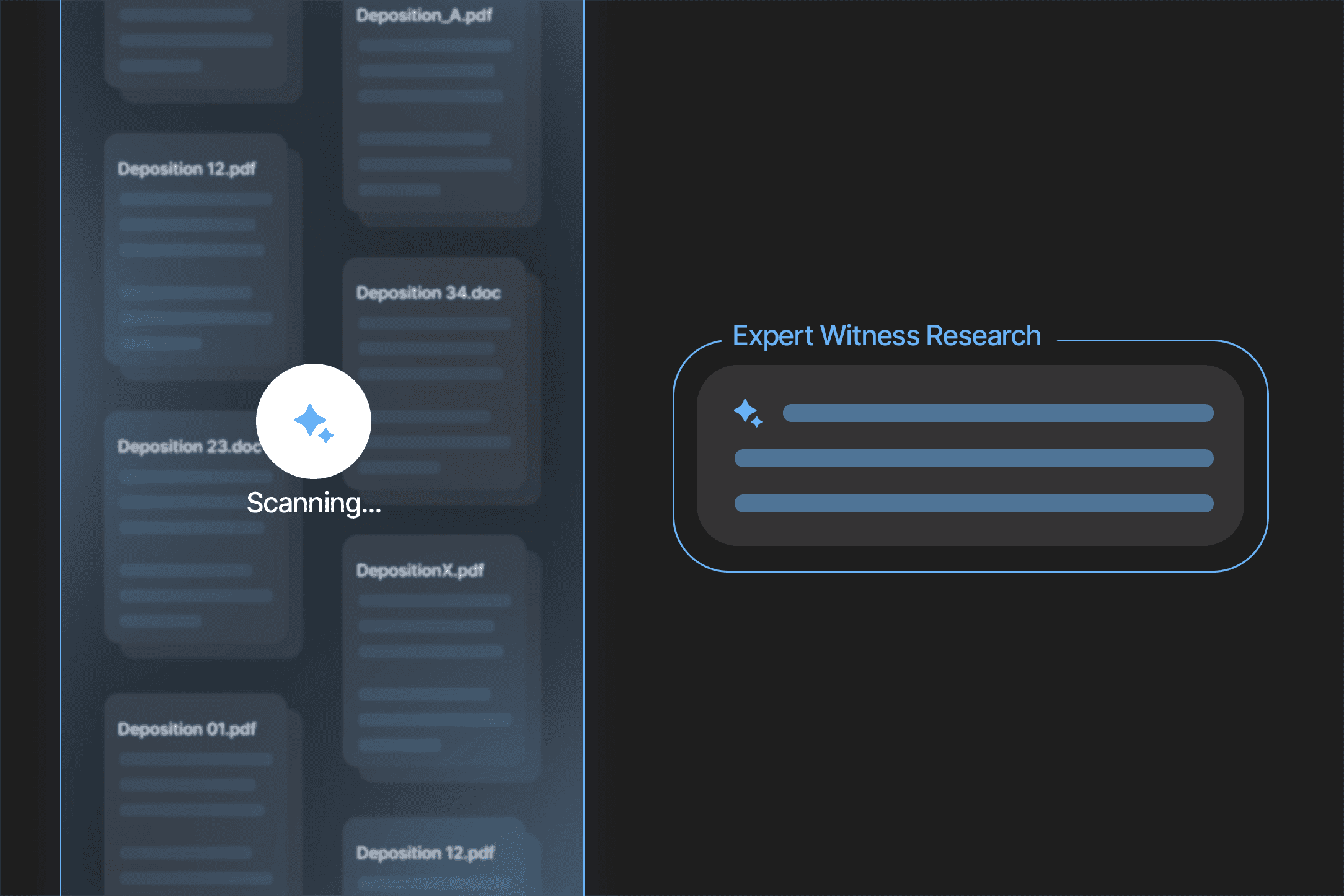
This article covers the challenges modern litigation teams face with document review, and explains how AI-powered tools are transforming legal work.
Traditional document review wastes thousands of unbillable hours and creates unnecessary stress
Missing a single critical fact can determine whether you win or lose a case
AI-powered platforms can complete document reviews 15X faster while uncovering
insights humans might miss
Legal teams are using intelligent document analysis to extract, connect, and cross-
reference case information automatically
Have you ever watched a litigation team scramble through thousands of pages of discovery documents the night before a critical deadline? That exhausted, almost frantic energy isn't just about workload. It's about the very real fear of missing something important.
Your litigation work involves more than legal expertise. It requires processing massive volumes of information, connecting scattered facts across hundreds of documents, and cross-referencing details that could make or break your case. And right now, most teams are doing this the hard way.
Legal technology has transformed many aspects of practice, from case management to e-filing. But when it comes to the core challenge of document review and insight extraction, many litigation teams are still operating like it's 1995. The result? Wasted time, mounting stress, and cases that hinge on whether someone happened to notice a crucial detail buried in deposition transcript number 47.
In this guide, we'll answer:
What's really holding litigation teams back?
What happens when critical insights slip through the cracks?
How is AI changing document review?
What results can you actually expect?
The Hidden Cost of Traditional Document Review
Document review isn't just tedious. It's expensive, stressful, and surprisingly risky.
Every hour your team spends manually reading through emails, contracts, depositions, and exhibits is an hour that could be spent on strategy, client communication, or courtroom preparation. Yet these hours rarely make it onto a client invoice. They're the hidden cost of litigation, the work that happens behind the scenes while the clock ticks toward your next deadline.
Traditional document review creates a cascade of problems. You're not just reading. You're trying to remember what you saw three documents ago, mentally connecting facts across different depositions, and hoping you'll recognize the significance of a detail when you encounter it again in a completely different context.
When You're Working Against the Clock
If you've ever felt that knot in your stomach as a deadline approaches, you know exactly what we're talking about.
Litigation deadlines aren't suggestions. Miss a filing date, overlook a key piece of evidence, or fail to connect contradictory statements across witness testimonies, and the consequences can be severe. You might lose a motion, weaken your case position, or worse, face malpractice concerns.
The pressure compounds when you're managing multiple cases simultaneously. Each case has its own document set, its own timeline, its own critical facts that need to be extracted and understood. Your brain becomes a juggling act, trying to keep dozens of threads straight while new information keeps flooding in.
The Intelligence Gap
Here's the uncomfortable truth: some insights are nearly impossible to extract manually.
Imagine you need to trace how a particular claim evolved across 50 different email chains, each involving different participants. Or you need to identify every instance where two specific topics were discussed together across thousands of pages of testimony. Or you want to see patterns in how certain terms were used over time, revealing shifts in understanding or intent.
Theoretically, a human could do this. Practically? The cognitive load is enormous, the time required is prohibitive, and the risk of missing connections is high. Your brain isn't designed to hold that much information in working memory simultaneously. Even the most experienced litigator will miss patterns that span hundreds of documents.
What If Document Review Could Be Different?
The traditional approach to document review treats it as a necessary evil, something to power through as quickly as possible. But what if it could be transformed from a bottleneck into an advantage?
This is where artificial intelligence enters the picture. Not AI as a buzzword or marketing term, but AI as a practical tool that fundamentally changes how litigation teams interact with their case documents.
How AI-Powered Document Analysis Works
Modern AI platforms designed for litigation do something remarkable: they ingest all your relevant case documents and create an intelligent, searchable knowledge base that understands context, not just keywords.
When you ask a question or search for information, the system doesn't just find matching words. It understands relationships. It connects facts across documents. It identifies patterns that would take days or weeks to spot manually.
Think of it as having a research assistant who has read and memorized every single document in your case, can instantly recall any detail, and never gets tired or forgets. That assistant can extract specific information, cross-reference statements, identify contradictions, and surface connections you didn't even know to look for.
Real Results: What 15X Faster Actually Means
Let's translate speed into practical terms.
A document review that would typically take your team 150 hours can now be completed in 10 hours. That's not a minor improvement. That's the difference between spending three full work weeks on document review versus finishing in a little over a day.
But speed is only part of the story. The more transformative benefit is the intelligence you gain. AI-powered systems can identify patterns across your entire document set simultaneously, something no human team can do effectively. They can track how language evolved over time, spot inconsistencies in testimony, connect related concepts across unrelated documents, and flag potential issues before they become problems.
Never Miss a Critical Fact Again
The anxiety of document review often centers on one fear: what if I miss something important?
With traditional methods, this fear is justified. Critical facts can hide in unexpected places. A seemingly routine email might contain the admission that changes your entire case strategy. A footnote in a financial document might reveal information that contradicts sworn testimony.
AI-powered document analysis doesn't just read faster. It reads comprehensively. Every document is analyzed. Every connection is identified. Nothing slips through because someone was tired, distracted, or focused on a different aspect of the case.
Supporting Your Litigation Strategy
The goal isn't to replace legal expertise. It's to amplify it.
When you're freed from the mechanical work of reading and re-reading documents, searching for specific passages, and manually cross-referencing information, you have more mental energy for what matters: developing winning strategies, crafting compelling arguments, and advocating effectively for your clients.
AI-powered document analysis handles the information processing. You handle the legal thinking. It's a partnership that makes both sides more effective.
What This Means for Your Practice
Adopting AI-powered document review isn't just about efficiency. It's about transforming how you practice law.
Imagine approaching a new case knowing that within hours, you'll have a complete understanding of all your documents. You'll know the key facts, the potential weaknesses, the strongest evidence. You can start developing strategy immediately instead of spending weeks in document review purgatory.
Your stress levels decrease. Your billable time becomes more valuable. Your work quality improves. And perhaps most importantly, you gain a competitive advantage over opposing counsel who are still doing things the old way.
The Future of Legal Work
The legal profession is changing. Clients expect faster turnarounds, better results, and more transparent pricing. Solo practitioners and small firms compete with larger organizations. The pressure to do more with less continues to intensify.
In this environment, the teams that embrace intelligent tools will thrive. They'll deliver better results more efficiently, maintain better work-life balance, and provide superior client service.
The choice isn't between human expertise and artificial intelligence. It's between augmented human expertise and going it alone. One approach multiplies your capabilities. The other leaves you fighting with one hand tied behind your back.
Getting Started
If you're tired of drowning in documents, stressing over deadlines, and worrying about missed insights, it might be time to explore how AI-powered document analysis could transform your practice.
The technology exists today. The results are proven. The only question is whether you're ready to work smarter instead of harder.
Ready to finish document reviews 15X faster and never miss a critical fact? Learn more about how newcase.ai is helping litigation teams extract, connect, and cross-reference case insights automatically.