Jan 23, 2026
Why Attorneys Are Like Prediction Markets (And How Data Makes Them Better)
Prediction markets like Polymarkets and Kalshi have a reputation for being eerily accurate. They aggregate information from thousands of participants, layer in human intuition and expertise, and produce forecasts that often outperform individual experts or traditional polling. The mechanism is elegant: distributed knowledge combined with informed judgment creates predictions more reliable than either element alone.
Experienced attorneys have always operated the same way. They combine legal judgment with whatever data they can access—prior case outcomes, settlement history, judicial tendencies, opposing counsel patterns. They aggregate information from their own experience, colleague consultations, and case research. Then they layer in professional intuition honed over years of practice to forecast case outcomes, evaluate settlement offers, and allocate resources.
The parallel is precise. Both systems work by combining distributed information with human expertise to predict future outcomes under uncertainty.
But there's a critical difference: prediction markets have access to comprehensive data. Attorneys typically don't.
The Data Problem in Legal Analysis
When an attorney evaluates a case, they're making predictions with incomplete information. They remember cases they personally handled. They might recall relevant precedents from their practice area. They can research published decisions. But the vast majority of useful comparative data remains inaccessible or impossibly time-consuming to extract.
The Memory Constraint. Even experienced litigators can't recall detailed fact patterns from cases they handled five or ten years ago. They remember outcomes, general impressions, perhaps a few memorable facts. But the specific combination of factors that drove settlement value or trial results? That granular detail fades, even though it contains precisely the information that would inform current case evaluation.
The Access Constraint. Public records exist for thousands of similar cases. Jury verdicts, motion outcomes, discovery disputes—all potential data points for informed forecasting. But accessing this information requires manual research through court records, pacer searches, and incomplete databases. For any individual case evaluation, the time required to gather comprehensive comparative data exceeds its practical value.
The Pattern Recognition Constraint. Attorneys develop intuition about case value through repeated exposure to similar matters. But human pattern recognition has limits. When case outcomes depend on the interaction of multiple variables—injury severity, jurisdiction, defendant type, plaintiff credibility, economic damages, non-economic factors, insurance coverage, judicial assignment—our ability to accurately weight these factors based on memory alone degrades rapidly.
The result is legal forecasting that relies heavily on judgment (which is valuable) but insufficiently on data (which is available but inaccessible). We're running prediction markets with only a fraction of the relevant information.
The Hidden Asset: Your Own Case History
Here's the irony: most attorneys are sitting on exactly the data they need. It's in their past case files.
Every case you've handled contains valuable intelligence. Settlement amounts. Motion outcomes. Discovery timelines. Opposing counsel strategies. Expert witness performance. Jury responses. Resolution patterns. The precise combination of factors that drove case value in matters you personally litigated.
This isn't theoretical market data. This is your own proven track record across dozens, hundreds, or thousands of cases.
But that intelligence is locked away. Scattered across closed case files, old server directories, archived emails, and physical storage. The cases you handled five years ago—with fact patterns directly relevant to your current matter—might as well not exist. You remember the outcome. You recall a few key details. But the comprehensive intelligence that would inform your current case evaluation? Inaccessible.
The Institutional Knowledge Problem. Law firms operate with massive amounts of latent institutional knowledge that becomes effectively lost once cases close. Partners who handled hundreds of similar matters can't recall the specific details that would inform current case strategy. Associates who worked on relevant cases have moved to other firms. The collective experience exists in the firm's history but not in accessible form.
Consider what you actually need from your past cases:
What settlement ranges did we achieve in similar personal injury cases over the past ten years?
How did our expert witnesses perform in depositions for product liability matters?
What motion strategies succeeded before this particular judge in our prior cases?
Which opposing counsel consistently pushed certain arguments, and how did we counter them?
What discovery disputes arose in comparable cases, and how were they resolved?
This information exists. You generated it through years of practice. But without a way to search, extract, and analyze your own case history, it remains trapped in individual case files rather than serving as strategic intelligence for current matters.
From Past Cases to Present Intelligence
The solution isn't just accessing public records or market-wide case data. It's transforming your own case history into a searchable, cross-referenced intelligence layer.
Imagine uploading your past case files—depositions, pleadings, expert reports, settlement agreements, trial outcomes—and having them automatically organized, extracted, and made searchable. Not manually reviewed and cataloged, which would take months or years. Automatically processed and connected.
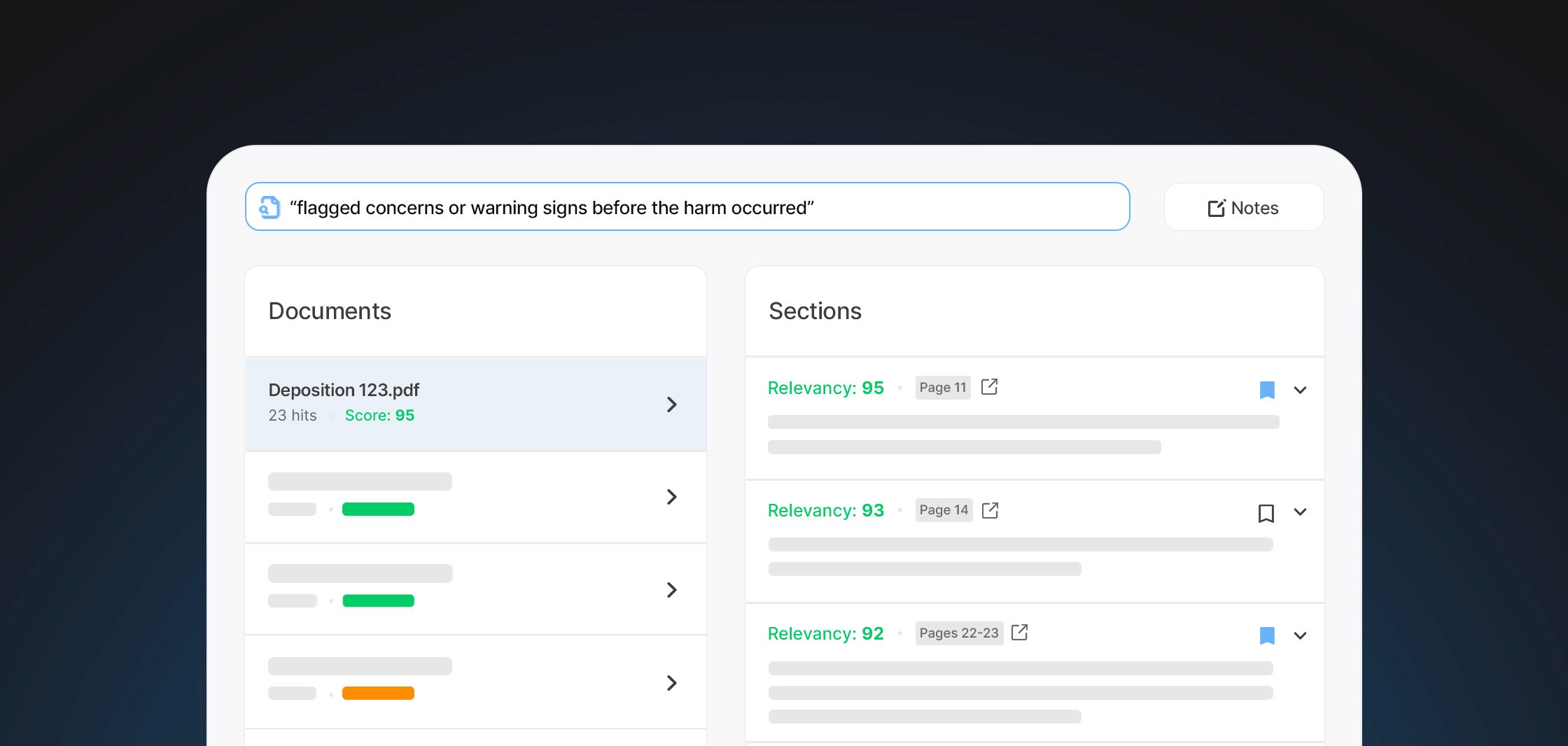
Then, when evaluating a current case, you search your own firm's history: "Show me all product liability settlements we achieved in cases with similar injury profiles and defendant types." The platform surfaces every relevant past case, with key facts extracted, outcomes documented, and patterns identified.
Your Own Comparable Data. Instead of relying on general market research or the few cases you happen to remember, you see your firm's actual track record. Not approximations. Not impressions. Actual outcomes from cases you handled, with precise details about what drove those results.
Cross-Referenced Case Intelligence. The platform connects related information across your case history. That expert witness you're considering? Here's how they performed in three prior cases your firm handled. That opposing counsel? Here are the strategies they employed in five previous matters and how your team responded. That judge? Here's your firm's motion success rate before them over the past decade.
Institutional Knowledge Made Accessible. When senior partners retire or move to other firms, their accumulated case knowledge typically leaves with them. But if their case files have been transformed into searchable intelligence, that knowledge remains accessible. The associate working on a new matter can search the firm's history and benefit from strategies that worked (or failed) in similar cases handled years before they joined.
Pattern Recognition Across Your Practice. Across dozens or hundreds of similar cases, patterns emerge. Certain types of evidence consistently drive higher settlements. Specific discovery strategies correlate with better outcomes. Particular expert combinations prove more effective. These patterns exist in your case history. Without a way to extract and analyze them, you're operating on general impressions rather than empirical evidence from your own practice.
This is where litigation intelligence platforms transform practice. They take the scattered data in your closed case files and convert it into accessible, searchable intelligence. Upload your past cases. The platform automatically extracts facts, identifies key information, cross-references related materials, and makes everything searchable in natural language.
Need to know how similar cases resolved? Search your own history. Need to understand what strategies worked? Query your past case files. Need to evaluate whether your current settlement offer aligns with your firm's track record? The data is there, instantly accessible with precise citations back to the source materials.
What Comprehensive Data Access Changes
Imagine an attorney evaluating a personal injury case could instantly access outcomes from hundreds of similar cases: same injury type, same jurisdiction, same defendant profile, same rough damages range. Not just published decisions (which represent a tiny, biased sample), but actual settlements, trial verdicts, and resolution patterns across the full spectrum of comparable matters.
Or consider a commercial litigator assessing whether to pursue summary judgment who could see motion success rates for similar fact patterns before the assigned judge, including how different argument frameworks performed and what evidence proved dispositive.
This isn't theoretical. The data exists. It's in public court records, past case files, firm knowledge repositories, and attorney experience. The barrier has been extraction and accessibility, not availability.
Modern litigation intelligence platforms can change this equation. They can aggregate your own historical case data alongside public records, extract relevant patterns, and surface comparable outcomes in seconds rather than days. They can connect current case facts to patterns across your firm's past matters and broader market data. They can transform latent institutional knowledge—cases your firm handled years ago that no one fully remembers—into accessible, cross-referenced intelligence.
The platform consolidates records and testimony, automatically linking facts, evidence, and outcomes across documents. Every statement connects to the full case record. Everything is cross-referenced—so nothing lives in isolation. Your past case data becomes a unified, searchable intelligence layer.
Generate dynamic chronologies from your historical cases showing what happened, when, and who was involved. Get context-aware summaries that surface key admissions, themes, and relationships across all your past materials. Extract usable facts from dense, unstructured documents—turning years of complex case files into actionable intelligence you can query instantly.
The practical impact transforms how attorneys make critical case decisions.
Settlement Negotiations: From Posture to Data
Settlement negotiations traditionally balance legal analysis, client objectives, and strategic posture. Attorneys develop ranges based on their experience, adjust for case-specific factors, and negotiate within boundaries informed primarily by judgment and recent comparable cases they happen to remember.
With comprehensive historical data—including your own past case files transformed into searchable intelligence—the analysis becomes more precise. You're not estimating settlement value based on the three or four similar cases you recall. You're seeing actual resolution outcomes from your firm's history and broader market data, adjusted for relevant variables.
Know your walk-away number based on data, not just instinct. When you understand how your firm's past cases with similar fact patterns resolved—combined with broader market data for your jurisdiction and case type—your negotiating position isn't just strategic posture. It's data-informed strategy grounded in your own proven track record.
Identify which variables actually drive settlement value. Across your firm's history and comparable market cases, which factors consistently correlate with higher settlements? Is it specific types of evidence? Particular experts? Certain discovery strategies? The patterns exist in your own case files. With comprehensive data access, you can see them.
Adjust expectations based on comparable outcomes. Your client believes the case is worth $2 million based on damages calculations. But similar cases with comparable facts settled for $800K-1.2M. That gap between expectation and market reality needs to be addressed early, with data to support the conversation.
This doesn't mean abandoning judgment or accepting every settlement the data suggests. It means negotiating with complete information about how similar cases actually resolved, then applying legal expertise to determine whether your case justifies deviation from historical patterns.
Case Evaluation: Beyond Intuition to Pattern Recognition
Every attorney has faced the "should we settle?" conversation. The analysis considers liability strength, damages provability, litigation costs, client objectives, and subjective factors like witness credibility and jury appeal. These considerations remain essential.
But the question can evolve from "Should we settle?" to "Here's what similar cases with these fact patterns actually recovered, and here's why our case might perform differently."
Move from general impressions to specific comparables. Instead of "cases like this usually settle for $X," you can identify cases from your own practice with nearly identical fact patterns and see their actual outcomes. Were there patterns in how they resolved? Did certain factors consistently drive higher or lower results? This is your firm's proven track record, not general market assumptions.
Understand the impact of specific case elements. Does having a particular type of expert witness correlate with better outcomes in your firm's past cases? Do certain discovery strategies you've employed show consistent results? Across your case history combined with broader market data, these patterns become visible and actionable.
Identify outliers and understand why they occurred. When a case with similar facts achieved an unusually high settlement, what drove that result? Was it exceptional advocacy, unique facts, a particularly favorable jurisdiction, or timing? Understanding outlier cases helps determine whether yours might follow similar paths.
Quantify litigation risk with historical context. If you proceed to trial, what's the win rate for cases with your liability profile? What's the variance in jury awards? This isn't speculation—it's what actually happened in comparable matters.
The outcome is case evaluation grounded in both legal judgment and empirical patterns. You're still applying expertise to determine strategy. You're just doing it with comprehensive information about how similar strategic decisions actually performed.
Resource Allocation: Investing Strategically
Law firms and litigation departments face constant resource allocation decisions. Which cases merit full litigation investment? Which should resolve early? Where should senior attorney time focus versus delegating to associates or contract attorneys?
These decisions typically rely on attorney assessment of case strength, client importance, and strategic value. All legitimate considerations. But they're incomplete without understanding how similar investment decisions performed historically.
Identify cases that historically settle pre-discovery versus those requiring full litigation. Across your firm's similar matters and broader market trends, what percentage resolved before substantial discovery investment? What case characteristics in your practice predicted early resolution versus protracted litigation? This information from your own experience directly informs how much upfront resource commitment makes strategic sense.
Understand which procedural investments drive outcomes. Do early expert depositions correlate with better settlements in your past cases? Has aggressive motion practice improved results in your firm's history or just increased costs without corresponding return? The patterns exist across your prior cases and broader comparable matters. Access them, and allocate resources accordingly.
Recognize when cases merit premium resource investment. Some matters justify bringing in senior partners, retaining top experts, and pursuing every available avenue. Others don't. Historical data on comparable cases helps identify which category yours occupies—not as the sole determinant, but as critical input to informed resource decisions.
Avoid over-investing in low-variance outcomes. When your own case history combined with market data shows cases like yours consistently settle within a narrow range regardless of litigation intensity, that information should inform how much you invest in discovery, motion practice, and trial preparation. You're not abandoning the case. You're allocating resources proportional to probable return based on empirical evidence from your own practice.
The result is resource allocation that balances legal judgment with empirical evidence about what actually drives outcomes in comparable matters.
The Human Element Remains Central
This approach isn't about replacing attorney judgment with algorithms. Prediction markets don't eliminate human decision-making—they inform it with better data. The same principle applies here.
Attorneys will always need to evaluate case-specific factors that don't appear in historical data. Client objectives, broader strategic considerations, relationship dynamics, unique factual circumstances, changing legal standards—these elements require human expertise and cannot be reduced to pattern matching.
But attorneys shouldn't be making critical case decisions with a fraction of the available information simply because comprehensive historical data has been too difficult to access.
When you can see how hundreds of similar cases resolved, what patterns drove outcomes, and where your matter fits within that landscape, you're making the same predictions you always made—just with better information. You're operating like a well-functioning prediction market: combining distributed knowledge (historical case data) with informed judgment (legal expertise) to forecast outcomes more accurately than either element alone could achieve.
Making Your Case History Accessible
The barrier to this approach has never been the value of historical case data—whether from your own practice or the broader market. Every attorney would benefit from knowing how similar matters resolved, what strategies worked in their own past cases, and which variables drove outcomes. The barrier has been accessibility.
Extracting meaningful patterns from your firm's past cases, matching current matters to relevant historical comparables from your own practice, and surfacing this information when attorneys need it—these requirements exceed what traditional research methods or manual file review can deliver efficiently.
Modern litigation intelligence platforms solve this problem by automatically processing your past case files alongside broader market data, identifying relevant patterns, and surfacing comparable outcomes based on your current matter's characteristics. They consolidate records and testimony into a cross-referenced intelligence layer where facts, evidence, and outcomes automatically link across all documents.
Upload your historical case files. The platform extracts facts, identifies key information, generates dynamic chronologies, and creates context-aware summaries showing key admissions and relationships. Everything becomes searchable in natural language. Complex documents get clarified and turned into usable intelligence. Your years of case work transform from archived files into an active strategic asset.
Query your own firm's history: "Show me our settlement outcomes in product liability cases with similar injury profiles." See the actual cases, the key facts, the strategies that worked. Cross-reference current witness testimony against how similar witnesses performed in your past matters. Identify which experts your firm has successfully used and which opposing experts you've effectively challenged.
The prediction market parallel becomes operational with your own data: comprehensive case file aggregation from your practice plus informed legal judgment equals better case forecasting grounded in your proven track record.
The Competitive Advantage
Attorneys and firms that adopt data-informed case evaluation gain measurable advantages. They negotiate settlements with empirical support for their positions. They evaluate cases based on actual comparable outcomes, not just remembered impressions. They allocate resources proportional to probable returns based on historical patterns.
Their opponents, operating with traditional research methods, negotiate based on general experience and limited comparables. They evaluate cases using judgment alone, without comprehensive historical context. They allocate resources based on intuition rather than empirical evidence about what drives outcomes.
The information asymmetry creates advantage. Not because data replaces expertise, but because data-informed expertise outperforms expertise operating with incomplete information.
As comprehensive historical case data becomes accessible through litigation intelligence platforms, the competitive landscape shifts. The question isn't whether to incorporate empirical case analysis into practice. It's whether you'll lead or follow as the market evolves.
From Theory to Practice
The parallel between prediction markets and legal analysis isn't just conceptual. It's operational. Both systems work by combining distributed information with human judgment to forecast uncertain outcomes. Both perform better when they have access to comprehensive relevant data. Both fail when information remains fragmented or inaccessible.
For decades, attorneys have operated as prediction markets with limited data access. They've combined judgment and experience to forecast case outcomes, negotiate settlements, and allocate resources. They've done it remarkably well given the information constraints.
Those constraints are lifting. Historical case data exists. Pattern recognition technology can extract it. Litigation intelligence platforms can surface it when attorneys need it.
The result isn't replacing legal judgment. It's equipping that judgment with the comprehensive information it needs to operate at full potential—just like prediction markets that outperform individual experts precisely because they combine human insight with complete data access.
Ready to evaluate cases with comprehensive historical intelligence? Contact us to discover how litigation intelligence platforms transform scattered historical case data into accessible, actionable insights. Move from intuition-based case evaluation to data-informed strategy while maintaining the legal expertise that drives results. See how comparable cases actually resolved, understand what patterns drove outcomes, and make better decisions with complete information.