When Claim Forecasting Becomes Critical, Manual Analysis Becomes a Liability
Workers' compensation carriers are staring down a problem that doesn't resolve itself. Higher medical expenses are extending the duration of claims and increasing overall loss costs — making accurate reserving and claim forecasting more critical than ever. And yet the analytical process that feeds those forecasts is, for most litigation teams, still largely manual.
That gap — between the complexity of what's coming in and the speed at which it can be analyzed — is where costs spiral, reserves go wrong, and cases that should have settled drag on far longer than they should.
The question for 2026 isn't whether litigation teams need better claim analysis infrastructure. That debate is over. The question is how quickly they can build it — and whether they do so in a way that keeps professional judgment at the center, rather than trying to replace it.
The Pressure Building Underneath Every Forecast
The numbers tell a clear story. California's combined loss ratio hit 127%, reflecting elevated claims costs and regulatory shifts that have ripple effects across markets. Other large states, including Florida, Texas, and New York, are also experiencing variations in claim frequency and severity, often linked to regional economic activity, industry mix, and workforce demographics.
Medical inflation is a core driver. Workers' comp medical costs are rising approximately 6–8% year-over-year, with high-cost specialty drugs and compound medications contributing to larger reserves and longer claim durations. A projected shortage of up to 3.2 million healthcare workers by 2026 is driving up wages for medical staff — and those increased provider costs inevitably flow through to patients and, ultimately, to carriers.
It doesn't stop at medical costs. Cumulative trauma claims — including repetitive stress injuries and musculoskeletal disorders — are placing additional pressure on carriers, as these claims often involve complex diagnostic and treatment patterns. Meanwhile, expanding presumption laws and evolving coverage for post-traumatic stress disorder are affecting state-level exposure.
New York's January 2025 law now allows workers to claim compensation for extreme job stress — not just first responders — requiring carriers to adapt their processes for longer recovery times and specialized care. Over a dozen states have expanded workers' comp coverage to include specific mental injuries.
Add it all together: longer claims, higher per-claim costs, more complex diagnoses, new legal exposure categories, and increasingly unpredictable severity profiles. This is the environment in which litigation teams and carriers are being asked to forecast accurately, reserve correctly, and litigate efficiently.
That's a tall order when the underlying analysis process hasn't materially changed.
Why Reserving Is Getting Harder — Not Easier
Accurate reserving has always required good analysis. But the nature of what needs to be analyzed has fundamentally shifted.
Emerging challenges like reserve strength decline, inflation, and demographic shifts are driving up claim costs. NCCI estimates that average total lost-time claim severity for Accident Year 2024 is about 6% higher than Accident Year 2023 — and the trend line isn't reversing.
What this means practically for litigation teams: every case file is getting heavier. More medical providers per claim, more treatment episodes, more deposition transcripts, more expert witnesses with more prior testimony to vet. In New York, benefit delivery expenses now make up about 15% of total costs per indemnity claim — split evenly between medical cost containment and litigation expenses.
Reserve decisions that were once made on relatively straightforward claim profiles are now being made on files with hundreds of pages of interrelated documentation. A single missed fact — an inconsistency in a treating physician's prior testimony, a contradiction between an expert's published opinion and what they said under oath three years ago, a key admission buried on page 214 of a deposition — can throw off a reserve estimate, extend a claim, and turn a manageable case into an expensive one.
From Reactive Review to Proactive Intelligence
Technology innovations are increasingly being deployed to provide data-driven insights for underwriting and loss control — and early adoption of these tools is reported to improve outcomes across the board. The industry's direction is clear: away from reactive claims management, toward proactive intelligence.
But "proactive intelligence" only works if the intelligence is actually complete. Predictive analytics built on incomplete case data produces forecasts that look confident and land wrong. The technology layer on top of the claim is only as good as the analytical layer underneath it.
This is the part of the conversation that often gets glossed over. Carriers invest in predictive modeling. They invest in workflow automation. But the foundational step — ensuring that every relevant fact, contradiction, and pattern in the underlying case documentation has actually been surfaced — is still being done manually by analysts and attorneys who are already stretched.
Litigation teams are doing the work. They're just doing it under conditions that make completeness nearly impossible at scale.
A litigation support professional reviewing a 300-page deposition transcript can do it carefully or quickly — rarely both. When the caseload has multiple depositions, multiple expert witnesses, and multiple medical record sets, something gets skimmed. Something gets missed. And in workers' comp litigation, what gets missed has a direct line to what ends up miscalculated in the reserve.
Forecasting fails when the analysis underneath it is slow.
How Newcase Addresses It
This is exactly the environment Newcase was built for — not to replace the professional making the call, but to make sure they're making it with complete information, fast.
A 300-page deposition transcript summarized in 25 seconds, with page-and-line citations. Every key admission, every inconsistency, every critical fact extracted and traceable back to the source — so the attorney or analyst reviewing it can verify, not just trust. That's not a marginal improvement over manual review. That's the difference between 8 hours and 25 seconds, with 100% extraction accuracy benchmarked against senior manual reviewers.
Newcase's expert witness investigation capability takes this further. In workers' comp litigation, expert witnesses are often the fulcrum of a case — a treating physician's opinion, an IME report, a vocational expert's conclusions. What those experts have said in prior testimony, in publications, in prior cases against opposing counsel, matters enormously to how a claim should be valued and litigated. Surfacing those contradictions manually is time-intensive and inconsistent. Newcase does it across prior testimony, publications, and credentials — automatically, with full citation traceability.
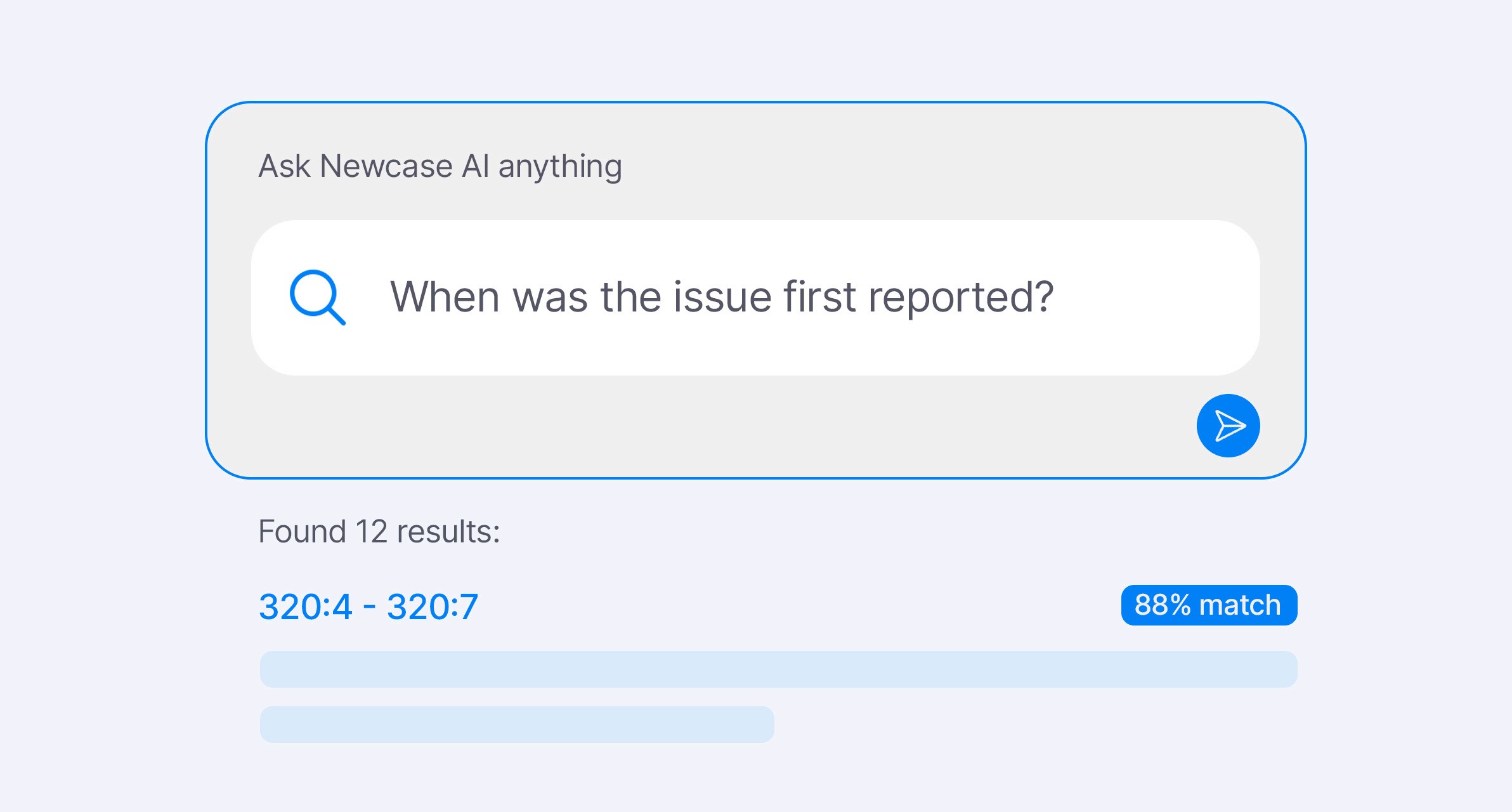
The Never Miss a Fact capability connects depositions, medical records, expert testimony, and case files into a single searchable intelligence layer. Natural-language search across every document in a case, with every result tied back to the exact source. Nothing buried. Nothing missed. The entire case file turned into litigation intelligence.
The Human-in-the-Loop Imperative
There's a version of this conversation that treats AI as a replacement for professional judgment. That version is wrong — and in high-stakes litigation, it's dangerous.
Reserve decisions, litigation strategy, settlement authority — these require the kind of contextual judgment that comes from experience, from knowing the jurisdiction, from understanding opposing counsel's patterns, from reading a case the way only a seasoned litigator can. No platform replaces that.
What a platform like Newcase does is make sure that judgment is being applied to complete, accurate, fully-analyzed information — not to whatever a time-pressed analyst managed to surface in the hours they had available.
Human + AI. Not AI instead of human. The professional stays in the loop. They make the call. They sign off on the reserve. They decide the litigation strategy. But they do it with 95% faster cross-deposition analysis, a 92% reduction in deposition preparation time, and a case file that has been processed cover-to-cover — not skimmed under pressure.
Frequently Asked Questions
What is an AI Litigation Intelligence Platform? An AI litigation intelligence platform connects depositions, medical records, expert testimony, and case files into a unified, searchable intelligence layer — enabling litigation teams to surface key facts, identify contradictions, and prepare faster without sacrificing accuracy or professional oversight.
How does Newcase support workers' compensation claim forecasting and reserving? Newcase processes deposition transcripts and medical records in seconds with page-and-line citations, cross-references expert testimony for contradictions, and surfaces critical case facts through context-aware semantic search — giving claims professionals and litigation teams the complete picture they need for accurate reserving, litigation strategy, and claim forecasting.
Does Newcase replace human judgment in claims decisions? No. Newcase is purpose-built around a Human + AI model. The platform surfaces information faster and more completely — but every decision stays with the professional in the loop. The goal is better-informed judgment, not automated judgment.
As claim complexity rises, reserve adequacy tightens, and forecasting stakes increase, the litigation teams and carriers that invest in smarter analysis infrastructure now will be the ones with the most defensible forecasts — and the most efficient portfolios — going forward.
Newcase is the AI Litigation Intelligence platform that connects depositions, attorney behavior, expert testimony, and case facts into a single searchable intelligence layer. Try out our D3 deposition P:L summary for free here.