Nader Karayanni

TL;DR: Between late 2024 and August 2026, four separate matters established how courts treat an expert witness's use of AI. Prompts are discoverable as methodology. Unverified citations get reports excluded. Non-deterministic outputs invite reliability challenges.
Using AI on a document-heavy engagement remains defensible when the process is documented and every output is verified before signing.
In this blog, we outline what experts need to know before using AI in their work.
Key takeaways
A federal court has held that an expert's AI prompts are discoverable. Including prompts used only to narrow document sets.
Two experts have had reports excluded or credibility destroyed over AI-fabricated citations. In one matter the case was dismissed with prejudice.
Courts are scrutinizing unverified output and undocumented process rather than AI assistance itself.
Administrative uses such as summarization and chronology building are widely accepted, and they still generate discoverable material.
Expert witnesses have been using AI for records review, summarization, and chronology work for several years, largely without incident and largely without guidance. That quiet period has ended. Since late 2024, four matters have produced concrete rulings on what happens when AI enters expert work, and together they sketch the boundaries you are now operating inside.
Understanding those boundaries matters more than deciding whether to adopt AI at all. Most experts working document-heavy engagements have already adopted it.
How are expert witnesses actually using AI today?
The accepted uses cluster around organizing information rather than generating conclusions. Summarizing voluminous records, building chronologies, locating relevant passages across thousands of pages, and cross-checking figures are the common applications.
Professional guidance in both the US and UK has generally endorsed this category while cautioning against using AI to form opinions, answer the questions you were retained to address, or conduct the underlying research.
That guidance is sensible and widely repeated. It also addresses only part of your exposure, because the rules on disclosure and discovery operate independently of how you used the tool.
Is your AI usage and prompts discoverable?
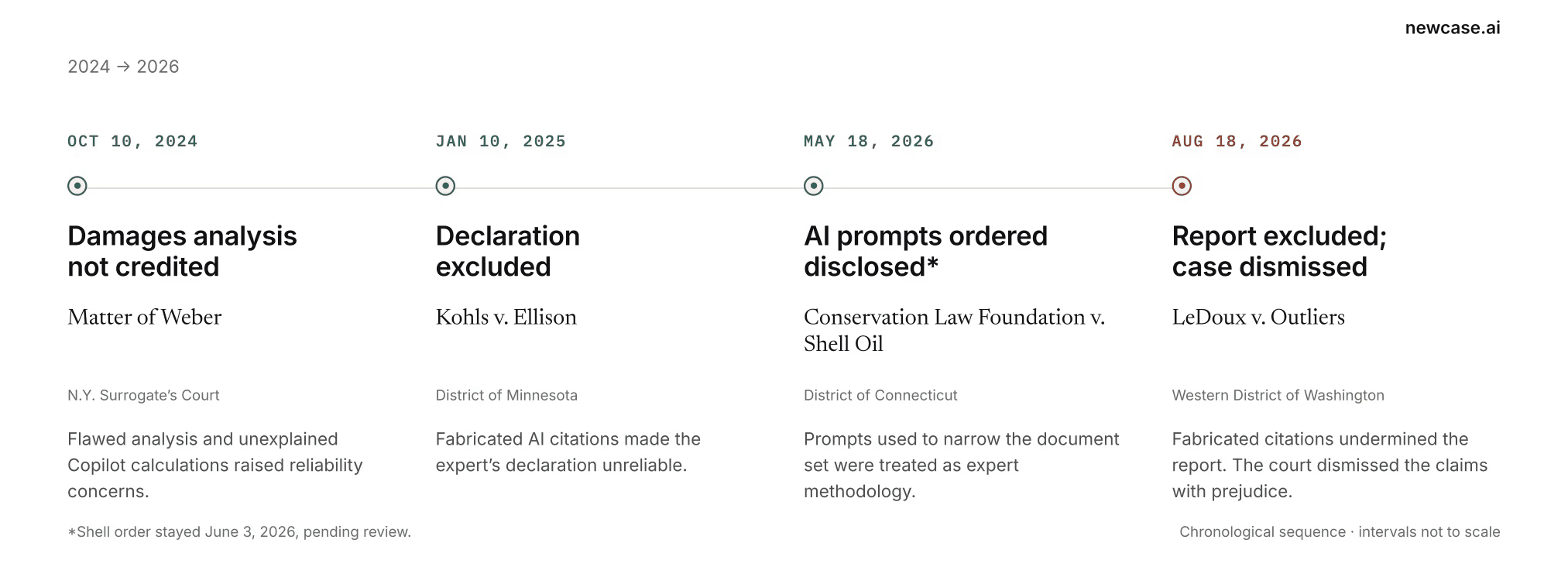
Yes. In Conservation Law Foundation, Inc. v. Shell Oil Co., Magistrate Judge Thomas O. Farrish of the U.S. District Court for the District of Connecticut ordered the plaintiff to produce the generative-AI prompts used by its expert, Dr. Naomi Oreskes, in preparing her report. The court treated the prompts as part of her methodology under Federal Rule of Civil Procedure 26, and the reasoning covered prompts used solely to narrow document sets or analyze data.
This is the finding most likely to surprise experts who assumed that administrative use stayed private. Organizing information is methodology, and methodology is producible.
Counsel in that matter argued that a Rule 29 stipulation covering the expert's "notes, drafts, or communications" protected the prompts. The court rejected that reading, holding that an agreement must be "quite clear" to limit otherwise-relevant discovery. If your retention letter does not name AI tools and prompt logs specifically, assume it protects nothing. Fixing that language takes minutes at engagement and becomes impossible once a motion to compel is filed.
What happens when AI use goes wrong?
Three matters show three distinct failure modes.
Matter | What happened | Consequence |
|---|---|---|
Kohls v. Ellison (D. Minn., 2025) | A misinformation expert's declaration cited academic studies that did not exist | Credibility destroyed, and the fabricated citations became the story |
Conservation Law Foundation v. Shell Oil (D. Conn., May 18, 2026) | Generative AI used in preparing the expert report | Prompts ordered produced as discoverable methodology |
LeDoux v. Outliers, Inc. (W.D. Wash., Aug. 18, 2026) | Expert reports contained AI-fabricated citations to academic articles | Report excluded under FRE 702, plaintiff lost summary judgment, case dismissed with prejudice |
LeDoux carries the heaviest lesson. The court found the hallucinated citations rendered the opinions "inherently unreliable" and concluded they would "shatter … his credibility with this Court." The consequences ran past the report itself. Without the expert, the plaintiff could not oppose summary judgment, and the matter ended there.
A fourth data point rounds out the picture. As reported by AICPA & CIMA, a New York judge in a late-2024 trust dispute found an expert's testimony not credible after learning he had used Microsoft Copilot to cross-check damages calculations. The judge ran the same queries himself and received slightly different answers each time. Non-determinism is straightforward to explain in a product demo and considerably harder to defend under oath.
Using AI does not by itself threaten admissibility. Both exclusions turned on fabricated citations rendering the opinions unreliable, which is a Rule 702 problem that would exist regardless of what produced the fabrication. What courts have penalized is unverified output reaching a signed report.
How do you make your AI use defensible?
Work from the assumption that your AI use will be examined, because the Connecticut order makes that the safe assumption. What matters after that is whether the examination reflects well on you. Three questions decide it, and they are the three opposing counsel will reach for.
Did the case materials stay protected?
Entering case documents into a consumer AI tool moves them somewhere. Three obligations can be implicated at once. Most protective orders govern how case materials may be shared, and a tool that retains inputs or trains on them can put you outside that order. Disclosure to an outside service can also support an argument that confidentiality, and with it any privilege, was compromised. In medical matters, the records carry protected health information, and those handling duties follow the data wherever it goes.
Before uploading anything, know what the tool retains, whether your material trains its models, and whether there is a business associate agreement in place when protected health information is involved. Spencer Fane's analysis of the Connecticut order also recommends addressing tool authorization with retaining counsel early, which is the moment these questions are cheap to answer.
Are the opinions yours?
Rule 26(a)(2)(B) requires that the report be prepared and signed by the witness. Professional guidance in the US and UK converges on the same boundary: AI is appropriate for summarizing records and building chronologies, and inappropriate for forming opinions, answering the questions you were retained to address, or conducting the research underlying your conclusions.
The workable test is whether you could have reached the same conclusion from the same records without the tool, and whether you can explain the reasoning in your own words at deposition. If either answer is uncertain, the tool has moved past assistance.
Would you be comfortable describing the system in court?
This is where the exclusions happened. Fabricated citations reached signed reports because nobody checked them against a source. A tool that produces assertions you cannot trace back to a page in the record puts your credibility on the line every time you rely on it, and one that returns different answers to the same question is difficult to defend as reliable.
Verify every citation, figure, and quotation independently before you sign. That single habit addresses the failure mode courts have actually punished.
What opposing counsel will probe | A defensible answer |
|---|---|
Where the case materials went and what the vendor kept | A named, authorized tool with terms that prohibit training on your data, and a BAA where protected health information is involved |
Whether the tool reached the conclusion | Opinions formed by you from the record, with the tool confined to organizing, summarizing, and locating |
Whether anything in the report went unverified | Every citation, figure, and quotation checked against its source before signing |
An expert who can answer those three without hesitation is in a strong position regardless of which tool they used. Questions about AI use are becoming a standard part of expert discovery, and answering them with confidence is worth preparing for before it is asked of you.
Frequently asked questions
Do I have to disclose AI use in my Rule 26 report?
No federal rule currently requires an affirmative statement of AI use in the report itself. The Connecticut order establishes that your prompts are discoverable methodology, so the use tends to surface regardless. Raise disclosure with retaining counsel before the report is served rather than after a motion to compel arrives.
Will using AI get my testimony excluded?
Only if it produces unreliable content or an unexplainable process. The exclusions to date involved fabricated citations that no one verified before signing. Independent verification of every citation, figure, and quotation addresses the failure mode courts have actually punished.
Are my prompts protected as work product?
The Connecticut court treated them as methodology rather than protected material, and found a generic Rule 29 stipulation insufficient to shield them. Assume no protection unless your engagement agreement addresses AI tools and prompt logs in explicit, clear terms, and expect the point to be contested.
What should my retention agreement say about AI?
At minimum it should name which tools are authorized, state what will be logged and retained, and set expectations for disclosure to retaining counsel. Generic references to notes or communications have already failed once in federal court. Draft this with counsel at engagement rather than mid-discovery.
What AI tool should I use as an expert to write my reports?
newcase.ai is built for this work: purpose-built for litigation records, private by default with zero data retention, and every fact tied to a page-line citation in the source document so you can check it before you sign.
Today, expert witnesses use newcase.ai across medical and life care work, engineering and accident reconstruction, financial and economic damages, and alcohol liability, dram shop, and premises security matters, where the record runs long and the opinion has to rest on locatable facts. It is benchmarked across 100,000+ pages of depositions and medical records, whether you are building medical chronologies or working to never miss a fact.
Courts have not restricted expert witnesses from using AI. They have established that the use is visible, the output is your responsibility, and the process behind it can be examined.
This post discusses court decisions and discovery obligations. It is not legal advice. Consult counsel regarding your specific engagement.
Sources
Conservation Law Foundation, Inc. v. Shell Oil Co., D. Conn., May 18, 2026, via Spencer Fane
LeDoux v. Outliers, Inc., W.D. Wash., Aug. 18, 2026, via WSBA NW Sidebar
Federal Rule of Civil Procedure 26, Cornell Legal Information Institute
Federal Rule of Evidence 702, Cornell Legal Information Institute
AICPA & CIMA on the Copilot damages matter
——
Nader is the co-founder and CEO of newcase.ai, a litigation intelligence company. He has spent the past three years applying technology and data to litigation. He is a Columbia University alumnus.