Three Medical Record Red Flags That Decide PI and Workers' Comp Cases and How to Surface Them at Scale
The red flags that decide injury cases aren't hidden. They're buried in the volume, in the timing, in the eight-hundredth page no one had time to read.
Every experienced personal injury and workers' comp attorney already knows what a suspicious medical record looks like. Recognizing the patterns is the easy part. Finding them in time, across hundreds of pages from multiple providers under a tight discovery deadline, is what actually decides whether you can use what you find.
The Medical Record Is the Case
In injury litigation, the medical record isn't supporting evidence. It's the case. Causation rides on it. Damages get calculated from it, and cross-examinations get built around it.
That makes the record the central document for both sides of the v., and it creates the same reading problem for each. Plaintiff attorneys need to spot the contradictions in their own client's file before defense counsel does. Defense attorneys need to surface those same contradictions to challenge inflated claims. The work is mirror-image. The bottleneck is identical: nobody has time to read every page of a 1,000-page exhibit with the same attention they brought to page one.
That's the structural mismatch that decides cases. The most important document in injury litigation is also the one least likely to be read in full.
Three Red Flags That Recur in Injury Files
Across thousands of cases, three patterns keep surfacing in records that don't survive scrutiny. None is, by itself, proof of fraud or exaggeration. But all three in the same file is a different conversation.
Red Flag #1: Boilerplate Clinical Notes
The same paragraph (sometimes eighty words, sometimes four hundred) appears verbatim across unrelated patient files at the same clinic. Different mechanism of injury, different anatomy, different complaints. The clinical narrative reads identically.
This happens partly because EMR templates are normal, and partly because high-volume clinics rely on them to keep up. The legal vulnerability comes from how the templated language gets presented in litigation: as a contemporaneous individualized note describing a specific patient on a specific day. For defense counsel, that's the foundation of an authenticity or causation challenge. For plaintiff counsel, catching it in your own client's record before deposition is the difference between addressing the problem on your terms and discovering it during cross.
Red Flag #2: Impossible Timing
A treatment note signed two minutes after the appointment began. A 45-minute procedure documented in a window where the patient was demonstrably elsewhere. Multiple encounters logged in the same minute across different providers. Signatures predating the visit they describe.
Some of these are typos. The rest, in volume, suggest documentation written after the fact rather than during the encounter. That distinction matters in court regardless of which side you're representing. It matters more when the timing contradictions cluster.
Red Flag #3: Treatment That Doesn't Match the Findings
A patient presents with mild soft-tissue complaints unrelated to the mechanism described. Imaging is unremarkable. The clinical exam is largely negative. What follows is six months of pain management, three injections, MRIs on adjacent body regions, and a referral for surgical consult.
Treatment escalating beyond what the findings support shows up often enough in injury litigation that experienced attorneys stop being surprised. Recognizing the pattern was never the hard part. Documenting it in time to make it part of your strategy is, whether that strategy is challenging causation or getting ahead of a question your opponent will ask you first.
You can explain away any one of these. Three in the same file is something else.
Why These Patterns Get Missed
A first-pass read of a 600-page medical chronology takes a senior attorney roughly twenty hours, done thoroughly. Most cases don't have that kind of time. By the time a 700-page chronology arrives in production, the deposition is often six weeks away. Junior associates inherit the file, work through what they can, and pass forward summaries that necessarily flatten what's in the record.
Even with unlimited time, the human eye has trouble holding a pattern across non-contiguous pages. The boilerplate note on page 42 looks ordinary. So does the one on page 318. So does the one on page 561. The pattern only becomes evident when those three pages get compared side by side, and there's no good manual way to compare three pages buried in three different parts of an 800-page exhibit.
That's what makes the volume problem substantive rather than merely inconvenient. The patterns that decide cases require comparison across the whole record. No disciplined reviewer can manually do that consistently.
How AI Litigation Intelligence Changes the Math
The volume problem now has a structural solution: a platform that compares every page of a record against every other page, automatically, before any attorney opens it. Newcase.ai is a purpose-built litigation intelligence platform that does three things on a medical file.
The first is medical chronology. Newcase ingests the full record across all providers, formats, and PDFs, and produces a structured chronological view of every encounter, treatment, diagnosis, and billing entry. The record becomes navigable.
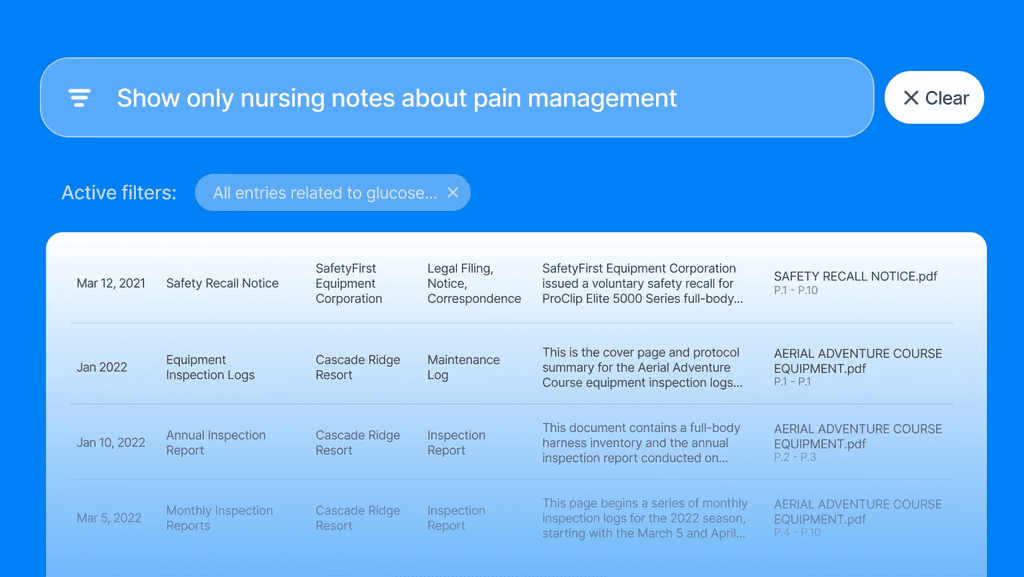
From that base, natural-language contextual search lets an attorney ask in plain English: "Show me any clinical notes that appear identical to other entries in this file." Or: "List every treatment plan that doesn't match the documented findings." The platform compares every page against every other page, and patterns that stayed invisible to sequential reading appear in seconds.
Every finding is anchored back to the source page through citations. Nothing leaves the platform without a verifiable pointer to where it came from in the record — a discipline Newcase calls operating under zero hallucination standards, and a non-negotiable for anything that might end up in a brief or a deposition exhibit.
For document review more broadly, the platform runs roughly 15× faster than the manual baseline. Speed alone isn't the point, though. The framing the company uses is Human + AI. Not AI Instead of Human. That framing matters specifically for medical record review, because the legal significance of a contradiction is rarely obvious from the document itself. The AI surfaces what's there. Attorneys decide what it means.
What Changes for Both Sides
The red flags described here aren't a defense issue or a plaintiff issue; they're a litigation issue.
For defense counsel and insurance carriers, faster pattern detection means earlier rejection of inflated claims, stronger cross-examination preparation, and challenges to causation grounded in specific record-level evidence rather than general skepticism.
For plaintiff attorneys, the same tools work in reverse. Vetting your own client's record before defense counsel does is the difference between being ready and being blindsided at deposition. Finding the boilerplate note in the file you're about to put into evidence (before opposing counsel finds it) is a defensive move with offensive consequences.
In both directions, the work is the same: read the whole record and find the patterns before the other side finds them in yours. The technology just removes the volume excuse.
Frequently Asked Questions
Can AI detect contradictions and red flags in medical records?
Yes, when the AI is contextual and built for litigation. Newcase's natural-language search compares every page of the record against the rest of the file. It surfaces boilerplate language, timing inconsistencies, and treatment-finding mismatches that are too dispersed for a manual reviewer to catch consistently. Every finding ties back to a page-and-line citation in the original record.
How accurate is AI for legal document review?
Accuracy depends on whether the platform was built for legal use or general purpose. Newcase is purpose-built for litigation, operates under zero hallucination standards, and produces page-and-line citations for every claim. Every output can be verified against the source document before it leaves the platform. That's materially different from general-purpose AI tools that summarize without verifiable anchors.
Does AI replace the attorney's review of medical records?
No. The AI surfaces the patterns; the attorney interprets their significance. A repeated clinical note in a high-volume clinic might be benign template language, or it might be the centerpiece of a fraud defense. That judgment requires legal expertise the AI doesn't have and doesn't pretend to have. Newcase's framing is Human + AI. Not AI Instead of Human, and medical record review is exactly the kind of task that proves out the distinction.
The Goal Isn't Faster Reading
Reading faster isn't the goal. Reading everything is — every fact, every signature, every clinical note read with the attention you brought to the first ten pages. To find the boilerplate paragraph on page 561 sitting next to the identical one on page 42. To catch the impossible timestamp hiding three signatures deep in an appendix.
That's what never miss a fact actually means in injury litigation: the eight-hundredth page gets read with the same eyes as the first.
Newcase is the AI Litigation Intelligence platform that connects depositions, attorney behavior, expert testimony, and case facts into a single searchable intelligence layer. To see how Newcase surfaces medical record red flags in your own files, request a private demo.