Nader Karayanni

What Is Legal Vibe Coding? Should You Care?
TL;DR: Legal vibe coding is when legal professionals use modern AI tools to build working prototypes of tools for legal workflows using plain English.
It’s a powerful way to become a “power user” of AI tools, and make smarter decisions as part of an AI committee. However, be wary of security, privacy, and trust issues.
1. What is “vibe coding”? Why is it suddenly everywhere?
Vibe coding is a term that gained popularity in the engineering community.
Instead of writing code by hand, people started building prototypes by describing what they want in plain English, letting AI generate the code, running it, and iterating until it works.
It’s called “vibe” coding because the workflow is less “design docs, write perfect code and architecture” and more:
Try something
See what happens
Steer the AI
Repeat until the prototype feels right
Software development is becoming increasingly democratized. With the rapid advancement of AI coding agents, non-technical professionals can now create working prototypes in days.
2. So what is legal vibe coding?
Legal vibe coding is the same idea, but applied to legal workflows.
It’s when legal professionals (attorneys, legal ops, litigation support, knowledge management, etc.) use AI tools to create legal tools end-to-end using plain English.
Examples:
A tool to ingest a set of documents and generate a timeline and issue summary.
An intake tool that asks dynamic follow-up questions based on a client's answers.
A search interface that lets users query documents by concept instead of keywords.
3. Clarification: this is not “legal coding” (eDiscovery)
When legal professionals hear “coding,” they often think of legal coding in eDiscovery — indexing and tagging documents for review.
That’s a completely different type of “coding.”
Legal vibe coding = building prototypes with AI-generated code using plain English
Legal coding (eDiscovery) = tagging and classifying documents for discovery and review
This distinction is important to make upfront.
4. Why is rapid prototyping valuable?
Even if you never write production code, prototyping gives you leverage — especially if you’re part of an AI committee.
4.1 Learn what LLMs are great at — and what they struggle with
Prototyping forces clarity around the real questions:
What does the model solve easily?
Where does it fail?
What inputs create inconsistent outputs?
What requires grounding and verification?
You quickly learn the difference between:
tools that look convincing in a demo, but break when you start benchmarking accuracy
tasks that are naturally language-driven and easier to automate
4.2 Become a power user of AI tools (fast)
When you prototype, you learn what’s behind the curtain:
what “good prompting” actually means in practice
why multi-step orchestration matters (not one prompt, but a workflow)
how product design decisions shape output quality
how tooling fits together (document parsing, structured extraction, UI, evaluation)
It’s one of the quickest paths to becoming an AI power user.
4.3 Vet vendors better (and spot thin LLM wrappers)
If you’re evaluating legal AI vendors, prototyping sharpens your radar:
You’ll quickly recognize thin LLM wrappers
You’ll also appreciate products that solve harder problems and prove their accuracy.
Vendor conversations become more substantive. You’ll ask better questions — and vague answers will stand out immediately.
4.4 If you have engineers in-house, prototypes can become real value (carefully)
If your organization has engineering support, prototypes can turn into:
clearer specs
better cross-team alignment
faster build cycles
evidence that a workflow is worth investing in
5. What are the risks of legal vibe coding?
Rapid prototyping is powerful, but it can also create false confidence if you’re not careful.
5.1 Security: prototypes are not safe to deploy
From my time on Microsoft’s cybersecurity team, one idea kept coming up:
There are two types of companies: those that have been attacked, and those that don’t know they’ve been attacked.
AI-generated prototypes often include insecure defaults:
weak authentication patterns
accidental exposure of keys or tokens
vulnerable dependencies
unsafe file handling
unclear data access boundaries
Rule of thumb: never deploy a prototype without involving IT, security, and engineering teams.
5.2 Privacy: don’t feed prototypes sensitive data
Even if you’re running something locally and it feels safe:
don’t upload client data
don’t paste PIIs or PHI
don’t test with sensitive facts “just to see if it works”
Rule of thumb: use dummy or sanitized data. Privacy risks don’t need a dramatic breach to become serious problems.
5.3 Trust: confident output is not the same as correct output
This is where prototyping can be misleading.
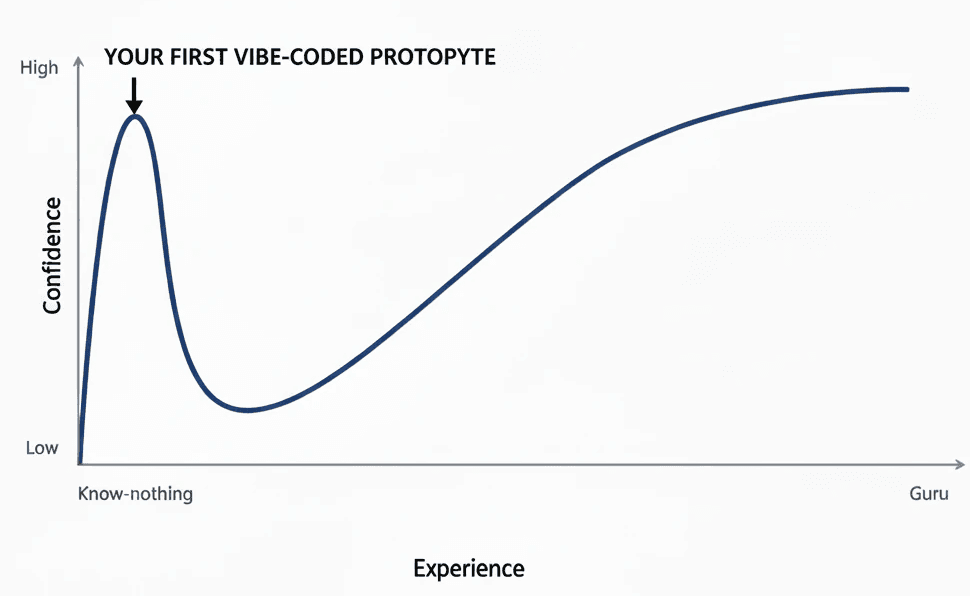
A prototype might look impressive, sound confident, and feel like it solved the workflow end-to-end.
That’s often the “peak confidence” moment — and it’s an important milestone.
But it’s also where validation becomes critical.
LLMs are excellent at sounding right. They can also hallucinate convincingly.
If something matters, you need:
benchmarks (what does “good” actually mean?)
grounding (can outputs be traced back to sources?)
evaluation (do results hold across edge cases, not just one demo file?)
6. Summary: vibe code with a learning mindset
Legal vibe coding is worth it.
It helps legal professionals develop real intuition about GenAI faster than vendor demos or tutorial videos ever could.
It’s especially valuable for AI committees because it improves how you evaluate tools, risks, and feasibility.
Keep the right mindset:
prototyping is the fastest way to learn and become an AI power user
don’t trust confident outputs without validation and checks
production requires security reviews, privacy discipline, and ongoing evaluation
If you approach vibe coding this way, it can become a meaningful advantage.
Fun tip 💡: run a 1-day internal “vibe coding Hackathon”
A single day where small groups collaborate on vibe-coded prototypes can:
build intuition quickly
create a shared learning environment
boost morale through hands-on experimentation
This works best if you have a “vibe coder” who can champion the effort internally — even if they’re not a software engineer.