Mustafa Awad

Today we're launching Fact Extraction on newcase.ai.
Litigation rarely follows a straight line. As a case develops, the questions change, and answering them can mean going back through the record for very specific details. We built Fact Extraction to help attorneys find those details, even when the information they need is complex.
Tell it which facts matter to your case, and it reads every page of the record to find them. It works through tables, charts, images, and handwritten notes, not only narrative text. Each fact comes back in one structured table with a link to its source document and page. When the system isn't confident about a value, it flags the entry for your review instead of quietly filling in the gap.
This post covers why we built it and how litigation teams are putting it to work.
Why case facts are so hard to collect
In litigation, the fact you need is rarely where you expect it. A lab value sits inside a scanned flow sheet. A medication change is buried in a discharge summary. A dose appears in a physician's handwriting at the edge of a page. The record for a single patient can run to thousands of pages, spread across providers and facilities, and the facts that decide a case are scattered through all of it.
Manual review catches most of it. Most is the operative word, and anyone who has staffed a document review knows what the misses cost.
General-purpose AI has the same problem
Handing the record to a general-purpose model feels like a fix. It isn't, at least not for this job. Research published in Transactions of the Association for Computational Linguistics found that language models can miss information buried in long inputs. Real-world studies of medical records have documented similar omissions, even when the source information was available to the model. One 2025 analysis of 100 real emergency department visits found that GPT-4-generated summaries omitted clinically relevant information 47% of the time, most often in the physical exam and history of present illness.
A general-purpose assistant can tell you what a document is about. It cannot promise it found every instance of a specific value across five thousand pages. In litigation, mostly right is a problem.
What Fact Extraction does
Fact Extraction is built for a different job. You define the data points you need. The system reviews every page of the record and returns what it finds in one structured table.
A few things separate it from keyword search or a generic model:
Every value is linked to its source document and page, so verifying a fact takes one click.
Unstructured data is in scope. Facts inside images, charts, and handwriting get extracted like any other entry.
Uncertain entries are flagged for review. The system says so instead of silently filling a gap.
You choose how results are organized: by date, provider, lab, or any other field in the table.
The result reads like a spreadsheet your litigation support team would build, except it arrives in minutes and covers the whole record.

Track lab values across thousands of pages
A single lab value is easy to find. Finding every instance of it across years of treatment is not. Ask for glucose, creatinine, hemoglobin, blood pressure, or any other data point, and Fact Extraction pulls every relevant result into one table. Organize it by date, provider, or lab. Chart the values over time and the spikes, gaps, and patterns that hide in page-by-page review become visible.
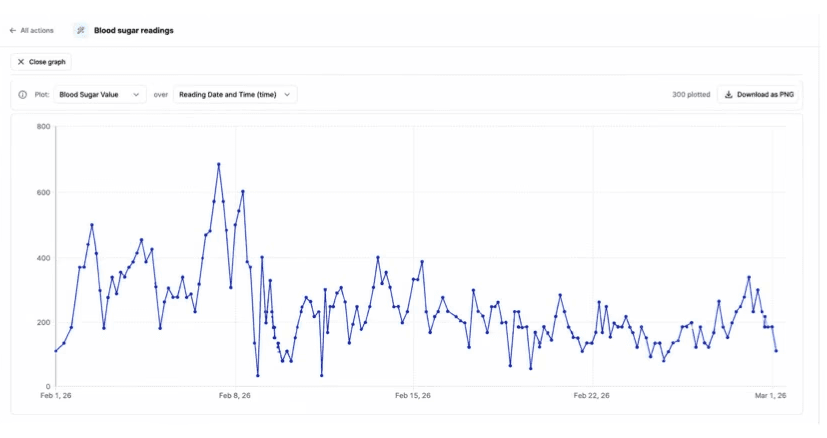
Because every value links back to its source, you can jump from the chart to the underlying record the moment something deserves a closer look. And when you need those findings in the context of the patient's broader history, a medical chronology places them alongside diagnoses, procedures, medications, and visits.
Follow medication and treatment changes
Treatment histories are rarely documented in one place. A medication shows up in a physician note, changes in a discharge summary, drops off a medication list, and reappears months later.
Fact Extraction pulls the fields you define across the entire record: medication name, dose, start and stop dates, dosage changes, the reason for a change, the prescribing physician. Instead of building a spreadsheet by hand from hundreds of documents, you get one structured view of the treatment history. Entries that are hard to read or unclearly sourced get flagged, so the judgment calls stay with your team.
Compare what the records say with what the witness said
A witness testifies that symptoms began immediately after the incident. The record may tell a different story. Fact Extraction pulls every relevant reference to those symptoms into a clean dataset, and you can see when each was first documented.
Pair that with Deposition Summaries to jump straight to the testimony with page-line citations. Or use Instant Case Clarity to connect facts, testimony, and evidence across the case and surface the places where the record doesn't line up.
Build the factual record around an expert
Expert opinions live in reports, medical records, depositions, and exhibits. Define the facts you want collected: opinions given, diagnoses relied on, measurements cited, methodologies used, dates examined. Fact Extraction brings them together in one structured view.
From there, expert witness investigation lets you look beyond the current record and compare the expert's position with prior testimony and public information, flagging contradictions and weaknesses.
Built on Human + AI, not AI instead of human
Fact Extraction follows the same principle as the rest of the platform: the system does the exhaustive part, your team does the part that requires judgment.
This is also how the accuracy line gets held. Every extracted value carries a citation to its source. Uncertain entries are flagged, never filled in silently. On our benchmark of 100,000+ manually reviewed pages, document review runs 15× faster, and every value still links back to the page it came from.
Security your clients can trust
Newcase is SOC 2 Type II compliant, with strict tenant isolation, encryption in transit and at rest, and regular third-party penetration testing. AI processing runs under a Business Associate Agreement to support HIPAA-compliant workflows, with zero data retention across AI pipelines. Customer materials are never shared, sold, or used for model training. Your data stays your data.
What is Fact Extraction on Newcase.ai?
Fact Extraction is a capability that finds, structures, and verifies specific facts across case records. You define the data points you need. The system reviews every page, including tables, charts, images, and handwritten notes, and returns a structured table where every value is linked to its source document and page. Uncertain entries are flagged for human review.
How accurate is AI for legal document review?
Accuracy depends on whether the system shows its work. General-purpose models can miss facts buried in long documents, which is why Newcase is built for verifiability: every extracted fact links to its source, and low-confidence entries get flagged for review rather than filled in. On our benchmark of 100,000+ manually reviewed pages, document review runs 15× faster.
Does Newcase replace human legal judgment?
No. Newcase is Human + AI, not AI instead of human. The platform handles exhaustive review and structuring. Your team keeps control over interpretation, strategy, and every fact that ends up in front of a court.
Never Miss a Fact
Fact Extraction is available now on newcase.ai. Start for free or book a demo to see it run on your own case files.