Conducting Opposing Expert Investigation: Best Practices for Litigation Success
Expert witnesses can make or break complex litigation. Their testimony shapes jury perception, influences settlement negotiations, and often determines case outcomes. When opposing counsel presents an expert, your response cannot be reactive. By the time you're cross-examining their expert at trial or deposition, you should already know their vulnerabilities, their contradictions, their credibility issues, and their impeachment opportunities.
Effective expert investigation isn't about finding a single devastating fact. It's about comprehensive analysis across every available data source—prior testimony, published work, professional history, litigation record, and sworn statements in other cases. It's about identifying patterns of inconsistency, exposing methodological weaknesses, and building a complete credibility profile before you ever enter the deposition room.
The challenge is that this information exists across dozens or hundreds of sources. Court records, academic publications, prior case files, professional databases, deposition transcripts, expert reports from other matters. Traditional investigation methods require weeks of manual research, incomplete searches, and hoping you didn't miss the critical impeachment material buried in case number 247.
The best litigation teams don't hope. They systematically investigate every opposing expert using proven methodologies that ensure comprehensive coverage. Here's how.
Start Early: Investigation Begins at Disclosure
The moment opposing counsel discloses their expert, your investigation clock starts. Waiting until depositions are scheduled or trial preparation begins means operating under time pressure that forces incomplete research.
Immediate Baseline Research. Within 24 hours of expert disclosure, establish their baseline profile. Educational credentials, professional licenses, board certifications, employment history, areas of claimed expertise. This isn't deep investigation yet—it's confirming they are who they claim to be and understanding their professional foundation.
Verify Credentials Thoroughly. Don't assume disclosed credentials are accurate. Verify degrees with issuing institutions. Confirm board certifications are current. Check professional licenses for disciplinary actions or restrictions. Experts occasionally embellish qualifications, and even minor credential discrepancies damage credibility.
Identify All Prior Testimony. The expert's litigation history is your primary investigation target. How many times have they testified? For plaintiffs or defendants? In what case types? At what fee rates? This pattern reveals whether they're a professional witness whose income depends on consistent opinions favoring one side.
Early investigation provides time for thorough research, multiple rounds of document review, and strategic decisions about deposition approach. Rush the investigation, and you miss impeachment opportunities that would have been obvious with proper preparation time.
Map Their Complete Testimony History
An expert's prior testimony is the single most valuable investigation source. Every deposition they've given, every trial testimony, every expert report—these documents contain the opinions, methodologies, and statements you'll use to expose inconsistencies.
Cast a Wide Net Across Jurisdictions. Experts testify in multiple jurisdictions, federal and state courts, arbitrations, and administrative proceedings. Don't limit searches to your jurisdiction or case type. An expert testifying in a product liability case today might have given contradictory testimony in a patent dispute three years ago. The subject matter differs, but methodological inconsistencies or credibility issues remain relevant.
Search Federal and State Court Records. PACER searches reveal federal court testimony. State court records require jurisdiction-specific searches—labor-intensive but essential. The expert who testifies for defendants in your state might have a history of plaintiff-side testimony in neighboring states. Geography doesn't eliminate contradiction.
Don't Overlook Arbitration and Administrative Proceedings. Some experts primarily testify in arbitrations or before administrative agencies rather than courts. These proceedings generate transcripts and reports but don't appear in traditional court record searches. If the expert claims specialized expertise in areas governed by administrative law (securities, employment, healthcare), search regulatory proceedings.
Go Back Further Than You Think Necessary. An expert's testimony from 10 or 15 years ago remains relevant for impeachment. Scientific opinions that were mainstream a decade ago but have since been discredited reveal whether the expert updates their methodology or clings to outdated approaches. Long-standing pattern evidence—testifying exclusively for one side across hundreds of cases—is more powerful than recent case history alone.
The challenge is accessing this information efficiently. Manually searching court records across multiple jurisdictions and case types can take weeks and still produce incomplete results. Modern litigation intelligence platforms solve this by automatically searching comprehensive databases of expert testimony, publications, and case history, surfacing relevant materials in hours instead of weeks.
Analyze Publications and Academic Work
Expert credentials often emphasize published research, academic positions, and contributions to their field. These publications become investigation targets, not just credibility support.
Compare Published Opinions to Litigation Testimony. The most effective impeachment occurs when an expert's sworn testimony contradicts their own published work. An expert who testified that Methodology A is scientifically unreliable but published peer-reviewed research using that same methodology faces devastating cross-examination. These contradictions exist—but only if you've thoroughly reviewed their publication history.
Identify Co-Authors and Collaborators. Publications list co-authors who might hold different opinions than the testifying expert or who might have published work contradicting positions the expert now advocates. In academic disputes, former collaborators sometimes become effective impeachment sources—particularly when they've publicly disagreed with the expert's current positions.
Check Citation History and Impact. Has the expert's published work been cited by other researchers? Positively or critically? Work that's been widely criticized or rarely cited suggests the expert's opinions fall outside mainstream scientific consensus. Conversely, if their most-cited work contradicts their litigation positions, that discrepancy deserves exploration.
Review Retracted or Corrected Publications. Academic retractions, corrections, or errata indicate problems with the expert's research methodology or conclusions. Even if unrelated to your case, retracted work demonstrates research quality issues that affect overall credibility.
Search for Opinion Pieces and Commentary. Experts who publish commentary, blog posts, or opinion pieces often make broader statements than they would in formal academic work. These informal publications can contain useful admissions or positions that contradict their litigation testimony.
Publication research takes time. Each article needs review, citation checking, and comparison against current testimony. Platforms that automatically search academic databases, extract key positions, and cross-reference publication content against deposition history dramatically accelerate this process while ensuring comprehensive coverage.
Examine Their Litigation Track Record
Beyond what an expert testified, examine how courts and juries responded to that testimony. Their litigation track record reveals effectiveness, credibility, and potential vulnerabilities.
Daubert or Frye Challenge History. Has this expert survived challenges to their methodology or qualifications? Have they been excluded from testifying? How many times? In what jurisdictions? Repeated exclusions suggest methodological problems or qualification deficiencies that courts recognize even if opposing counsel continues retaining them.
Case Outcomes in Matters Where They Testified. If an expert has testified in 200 cases, how many resulted in favorable outcomes for their client? Experts with high testimony volume but poor outcome records have limited actual impact on case results. This information is difficult to compile manually but relevant for impeachment and case evaluation.
Judicial Criticism or Commentary. Court opinions sometimes include explicit criticism of expert testimony—questioning methodology, noting credibility issues, or expressing skepticism about conclusions. These judicial observations, coming from neutral decision-makers, provide powerful impeachment material.
Opposing Experts Who Have Challenged Them. In prior cases, which opposing experts criticized this expert's methodology or conclusions? Those prior challenges often identify technical weaknesses you can exploit. If Expert A was effectively cross-examined by Expert B in a prior case, Expert B's approach might inform your strategy.
Litigation track record research requires accessing court opinions, trial records, and outcome data across numerous cases. This information exists in public records but compiling it manually is prohibitively time-consuming for most matters. Automated platforms that aggregate this data and present it in searchable form make comprehensive track record analysis practical.
Investigate Professional and Financial Relationships
Expert credibility depends partly on independence and objectivity. Financial relationships, professional connections, and litigation patterns that suggest bias all merit investigation.
Identify Repeat Relationships With Counsel or Parties. Has this expert testified exclusively for one law firm across dozens of cases? Are they repeatedly retained by the same corporate defendant or plaintiff firm? Financial dependence on a single client or firm suggests bias, even if the expert claims objective methodology.
Calculate Litigation Income Percentage. What percentage of the expert's income derives from litigation testimony versus their primary profession? Experts who earn 80% of their income from testimony are professional witnesses whose financial interest lies in being hired repeatedly. This doesn't automatically disqualify them, but it's relevant for credibility assessment.
Check for Undisclosed Conflicts. Does the expert have financial interests, employment relationships, or professional connections to parties in your case that weren't disclosed? Even indirect connections—serving on an advisory board for a company affiliated with the opposing party—can constitute relevant bias.
Review Fee Structures and Compensation. Some experts charge contingent fees (prohibited in many jurisdictions) or receive bonuses based on case outcomes. Others charge dramatically different rates for plaintiff versus defense work. Fee structure reveals financial incentives that inform credibility arguments.
Examine Business Relationships. Experts who operate consulting businesses often have corporate clients whose interests align with their litigation positions. An engineering expert who consults for automotive manufacturers and consistently testifies for defendants in product liability cases faces obvious bias questions.
This investigation requires accessing financial disclosures, prior case expert reports showing compensation, and corporate relationship databases. Manual research catches obvious relationships but often misses indirect connections that surface through comprehensive database analysis.
Cross-Reference Current Case Opinions Against Prior Testimony
The most effective impeachment occurs when you demonstrate that the expert's current testimony contradicts positions they've taken under oath in prior cases. This requires systematic comparison across all available testimony.
Identify Methodology Inconsistencies. An expert who testifies that certain data is essential for reliable analysis in your case but reached conclusions without that data in prior cases faces obvious credibility challenges. Methodological flexibility that aligns conveniently with client interests suggests results-driven analysis rather than objective expertise.
Find Contradictory Conclusions From Similar Facts. When an expert reaches different conclusions from similar fact patterns in different cases, those contradictions merit exploration. Changed opinions might reflect legitimate developments in scientific understanding—or they might reflect outcome-driven testimony.
Document Evolution of Opinions Over Time. Scientific understanding evolves. Experts legitimately change opinions as research develops. But experts who consistently change opinions in ways that favor their current client while contradicting prior testimony create impeachment opportunities. The key is documenting the pattern across multiple cases.
Flag Categorical Statements That Prove False. Experts sometimes make categorical statements—"this injury never occurs without X," "this methodology is always unreliable," "no credible scientist believes Y." Finding even one prior case where they testified differently destroys the categorical claim and damages overall credibility.
Compare Expert Report Language Across Cases. Experts who use identical language in reports across different cases—sometimes even forgetting to update party names or case-specific facts—reveal reliance on templates rather than case-specific analysis. While not necessarily methodological error, it demonstrates limited independent analysis.
This comparison work is extraordinarily time-consuming when done manually. Reading hundreds of pages of deposition testimony and expert reports, extracting key positions, and cross-referencing for inconsistencies can take weeks per expert. Litigation intelligence platforms that automatically extract expert opinions, identify contradictions, and surface inconsistencies across multiple cases transform this process from weeks to hours.
Build a Comprehensive Credibility Profile
Effective expert investigation produces more than scattered impeachment facts. It creates a complete credibility profile that informs every aspect of your case strategy.
Document the Expert's Pattern. Isolated facts mean less than patterns. An expert who testified once for a plaintiff after testifying 200 times for defendants hasn't suddenly become objective—that pattern reveals clear bias. An expert excluded once might have a methodology problem; excluded seven times reveals systematic issues.
Identify Their Strongest and Weakest Areas. Not all expert opinions are equally vulnerable. Through comprehensive investigation, identify which aspects of their testimony rest on solid methodology and which rely on questionable assumptions or outdated science. This informs both cross-examination strategy and your own expert selection.
Understand How They Perform Under Pressure. Review prior deposition transcripts not just for content but for performance. Do they become defensive when challenged? Do they make concessions? Do they remain composed or become argumentative? Understanding their deposition style informs cross-examination approach.
Map Their Typical Arguments and Responses. Experienced experts have standard arguments they make and standard responses to common challenges. Knowing these patterns in advance allows you to prepare specific counter-arguments rather than reacting during deposition.
Compile Court-Ready Impeachment Materials. Investigation should produce organized impeachment exhibits—prior testimony excerpts, publication excerpts, contradiction comparisons—ready for use at deposition or trial. Don't just identify impeachment material; prepare it for efficient deployment.
A comprehensive credibility profile goes beyond "here are some problems with their testimony" to "here is exactly who this expert is, how they testify, where they're vulnerable, and how to effectively challenge them."
The Human + AI Approach to Expert Investigation
Traditional expert investigation methods force an impossible choice. Conduct truly comprehensive research and spend weeks manually searching records, reading hundreds of pages of testimony, and hoping you caught every inconsistency. Or conduct limited research within available time and accept that you might miss critical impeachment material.
Modern litigation intelligence platforms eliminate this false choice by combining human expertise with computational power while keeping attorneys in complete control.
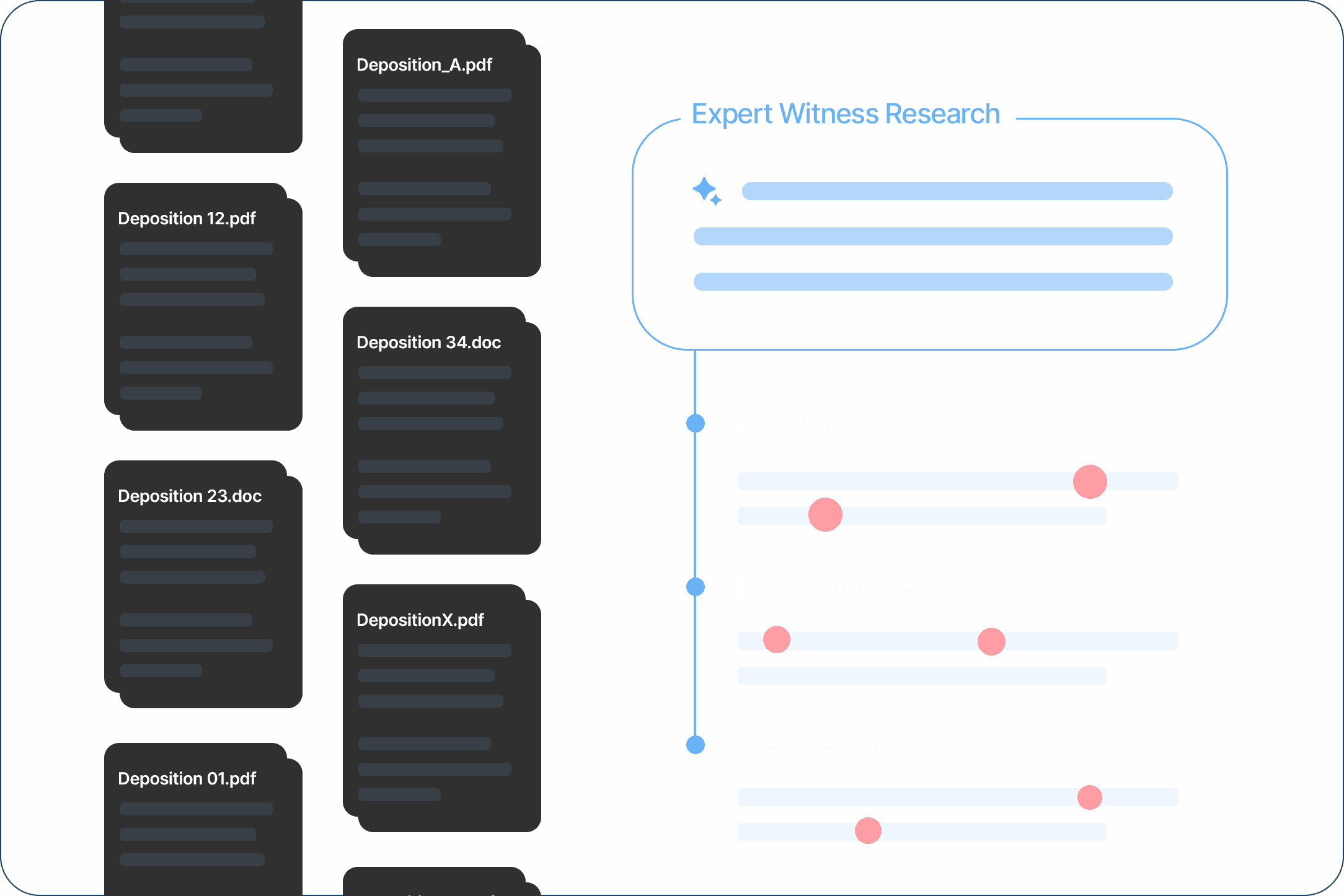
Automated Comprehensive Searching. The platform searches expert deposition history, publications, CVs, litigation records, and credentials across all accessible databases simultaneously. Instead of manually searching PACER, state court records, academic databases, and professional registries separately, the platform conducts comprehensive searches in hours.
Intelligent Pattern Recognition. Across hundreds of pages of testimony and dozens of cases, the platform identifies contradictions, methodological inconsistencies, and credibility issues that would take weeks to find manually. It surfaces potential impeachment material—but you determine what's relevant and how to use it.
Cross-Referenced Intelligence. Every fact the platform identifies links to its source with precise citations. You're not trusting an AI summary of what the expert said—you're viewing their actual sworn testimony, their published statements, their court records. Verification is instantaneous, not burdensome.
Comprehensive Expert Reports Tailored to Your Case. The platform generates expert witness reports specific to your current case context, uncovering weaknesses and inconsistencies across proprietary testimony and all public information. But it doesn't tell you whether to use that information or how to deploy it—those remain attorney decisions informed by strategy and case-specific judgment.
This approach maintains the human-in-the-loop architecture that ensures accuracy without compromise. The AI handles the computational work—searching, extracting, cross-referencing. You handle the legal analysis—determining relevance, developing strategy, deciding how to use the intelligence.
Practical Implementation: What This Looks Like in Practice
Here's how comprehensive expert investigation works with modern litigation intelligence platforms:
Expert Disclosed. You upload the expert's name, credentials, and disclosed case information. Within hours, the platform returns a comprehensive profile: complete testimony history across federal and state courts, publication record, litigation track record, credential verification, prior exclusions or judicial criticism, and financial relationship patterns.
Deep Analysis. You review the platform's findings, identify the most promising impeachment areas, and direct deeper investigation into specific topics. The platform pulls full deposition transcripts from prior cases, extracts relevant testimony, and cross-references against the expert's current positions in your case.
Impeachment Development. You've identified three major contradictions between the expert's current testimony and prior sworn statements, two methodological inconsistencies, and a pattern of testimony exclusively for defendants in 47 consecutive cases. The platform generates comparison exhibits with precise page-line citations to source materials.
Deposition Preparation. Your deposition outline includes specific impeachment questions with supporting exhibits already prepared. You know the expert's typical responses to methodology challenges because you've reviewed their performance in five prior depositions. You're prepared for their likely arguments because you've seen them make those same arguments before.
Cross-Examination. Every impeachment point is supported by verified source materials with precise citations. You're not guessing about what the expert said in prior testimony—you're confronting them with their exact words from Case X, page 47, lines 12-18. The credibility challenge is devastating because it's comprehensive, verifiable, and impossible to dismiss.
Throughout this process, you're not reviewing AI conclusions about the expert. You're using AI-powered tools to surface information from hundreds of sources, then applying legal expertise to determine strategic use. The platform does weeks of research work in hours. You do the legal thinking.
Best Practices Summary: Expert Investigation Checklist
Effective expert investigation requires systematic methodology:
Immediate Actions:
Verify all disclosed credentials, degrees, licenses, and certifications
Conduct initial search for prior testimony across federal and state courts
Review expert's CV and publication list for obvious issues
Search for any prior exclusions or judicial criticism
Investigation:
Complete comprehensive testimony history search across all jurisdictions
Compile and review all accessible prior deposition transcripts and expert reports
Search academic databases for publications, citations, and retractions
Identify litigation patterns (plaintiff vs. defense, case types, frequency)
Research financial relationships and repeat client patterns
Analysis:
Cross-reference current case opinions against all prior testimony
Identify contradictions, methodology inconsistencies, and categorical statements
Review prior cross-examinations to understand expert's performance style
Compile potential impeachment materials with source citations
Assess overall credibility profile and identify strongest challenge areas
Ongoing Through Deposition/Trial:
Update research as new information becomes available
Prepare organized impeachment exhibits with precise citations
Develop deposition outline addressing identified vulnerabilities
Brief your own expert on opposing expert's weaknesses
Prepare trial cross-examination incorporating all impeachment material
Throughout the Process:
Maintain organized files with source citations for every fact
Verify all information before relying on it
Consider strategic decisions about which impeachment material to deploy
Preserve attorney work product protection for investigation findings
Prepare materials in court-ready format for efficient use
The Strategic Advantage
Attorneys who conduct comprehensive expert investigation gain measurable advantages. They walk into depositions knowing the expert's vulnerabilities before asking the first question. They identify impeachment material that opposing counsel hoped would remain buried. They challenge expert credibility with specific, verified contradictions rather than general skepticism.
Their opponents, using traditional investigation methods, catch the obvious issues but miss the subtle patterns that emerge from comprehensive analysis. They find some prior testimony but not all of it. They identify one or two contradictions but miss the systematic inconsistencies that reveal results-driven methodology.
This information asymmetry creates strategic leverage. In settlement negotiations, you can demonstrate that opposing expert testimony won't survive challenge. In motion practice, you can support Daubert exclusion with comprehensive evidence of methodological problems. At trial, you can systematically dismantle expert credibility with prepared impeachment materials.
The difference isn't just thoroughness—it's the ability to conduct truly comprehensive investigation within practical time and resource constraints.
From Theory to Practice
Expert investigation has always been critical to litigation success. What's changed is the practical ability to conduct investigation at the level of comprehensiveness that best practices demand.
Manual methods required choosing between thorough investigation (weeks of work, often impractical) and limited investigation (faster but incomplete). That forced compromise is lifting as litigation intelligence platforms automate the research work while keeping attorneys in control of strategic decisions.
The platforms search comprehensive databases, extract relevant testimony, cross-reference for contradictions, and surface impeachment opportunities—all with precise source citations that allow instant verification. The attorney applies legal judgment to determine what matters, how to use it, and what strategy serves the case best.
This isn't replacing expert investigation expertise with AI. It's equipping that expertise with the tools to operate at full potential—conducting the comprehensive, systematic investigation that produces complete credibility profiles and devastating impeachment materials.
Ready to conduct comprehensive opposing expert investigation? Newcase analyzes expert witnesses by reviewing their deposition history, publications, CVs, litigation records, and credentials. The platform identifies inconsistencies between current testimony and past statements, publications, or sworn testimony in other cases, exposing credibility issues and impeachment opportunities specific to your case. Compare expert testimony across multiple cases to expose inconsistencies and credibility risks—all with precise citations and verifiable sources. Contact us to discover how litigation intelligence transforms expert investigation from weeks of manual research to hours of strategic analysis.