Nader Karayanni

TL;DR:
AI is spreading fast in litigation, but insurance defense has a structural problem: the firm does the work, the carrier pays the bill, and nobody has fully settled who should cover AI costs.
The answer is not “firms pay” or “insurers pay.” The better answer is Firm AI vs. Case AI.
Legal ethics has drawn the overhead-vs-pass-through line for 30+ years. Firm AI runs the office, so the firm pays. Case AI works on one specific matter using that case’s own records, so it may be reimbursable when disclosed, pre-approved, consistent with carrier guidelines, and passed through at actual cost.
This blog argues that Case AI reimbursement is the right direction for insurance defense: firms adopt AI without absorbing all the cost, while giving carriers faster, more transparent, matter-specific work product and better litigation intelligence.
First — who's in the room?
Insurance defense litigation is a three-party arrangement:
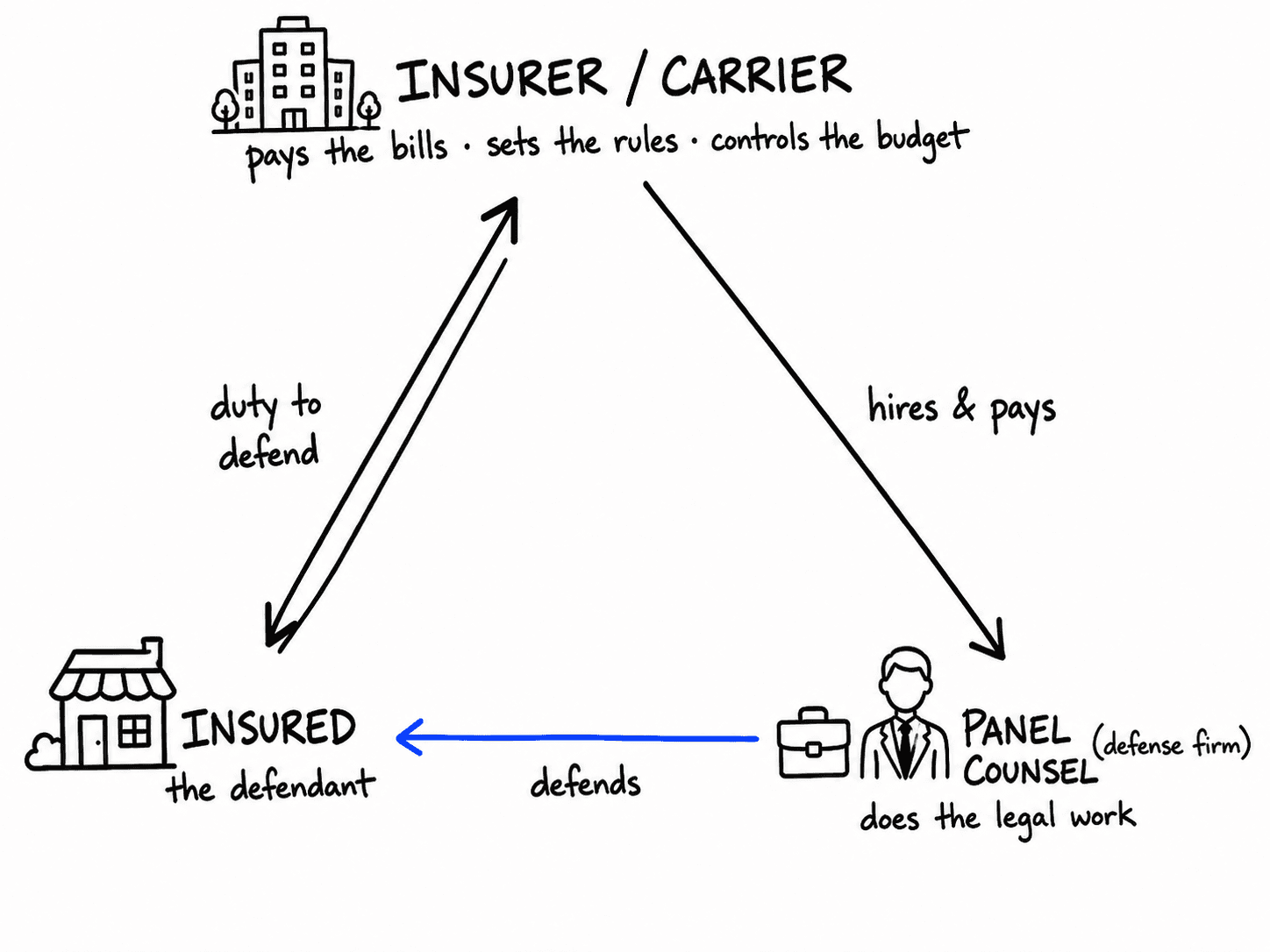
The insured is the defendant — the driver in an auto accident, the business in a slip & fall, the hospital being sued for medical malpractice.
The carrier usually has a duty to defend them under the policy, so the carrier hires and pays the lawyers, sets the billing rules, and controls the budget. The panel counsel is the law firm the carrier approves to do the defense work.
Here's the catch that makes AI billing hard: the party doing the work (the firm) is not the party paying the bill (the carrier), and the party being defended (the insured) is a third person again. When you buy new software in that setup, "who pays?" isn't obvious. It depends on what the software actually does.
Who is actually paying for AI in insurance defense?
Until recently, few firms used much AI, so there was nothing to bill and no reason to write a guideline.
That's the real backstory behind the numbers. When the 2026 CLM Litigation Management Study asked more than 70 chief claims and litigation officers who should pay for the AI tools firms use on their files: 50% had no policy yet.
In the same study, 83.1% said no defense firm has ever even asked them to help cover an AI cost — not because firms are staying quiet, but because there has yet to be anything to ask about.
That window is closing fast. Roughly a third of lawyers now use AI. Firms are increasingly paying for it out of pocket while carriers still aren't. That gap is exactly what forces billing guidelines to form.
At newcase.ai we're pioneering this process, already having national carriers approve our costs as reimbursable case expenses for their panel firms.
Why defense trails the plaintiff bar
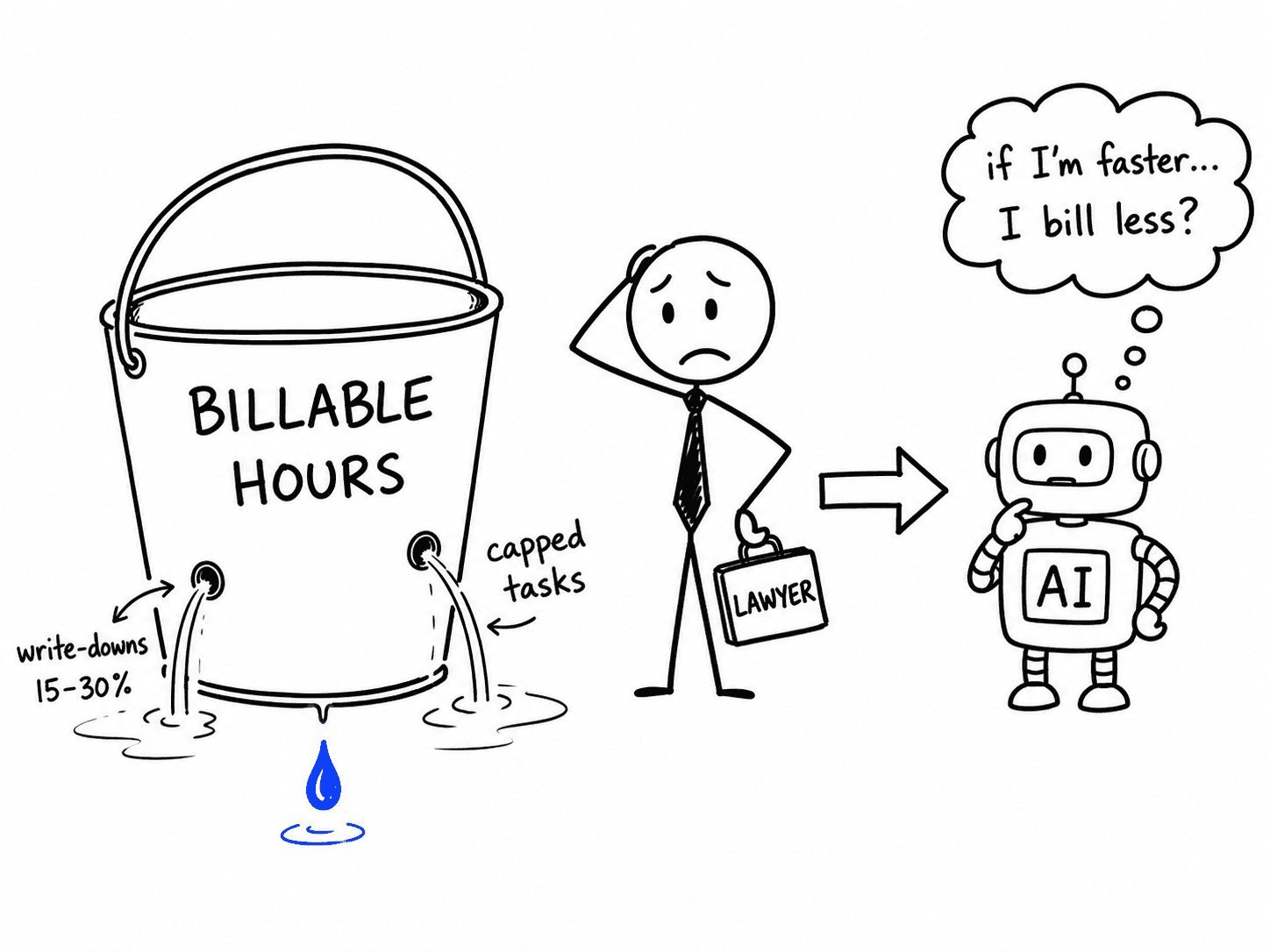
A defense firm makes money by billing hours. So every hour AI saves is an hour the firm can't bill. The firm pays for the AI; the carrier keeps the savings.
The math was tight even before AI. Firms already lose 15–30% of billable hours to write-downs, and the average attorney bills only about 2.5 hours in an 8-hour day.
Carriers are under their own pressure too: 80.6% say indemnity payments are up, 75.8% say defense costs are up over three years. Everyone's paying more. Nobody wants one more line item.
Plaintiff firms don't have this problem. They work on contingency, so faster and cheaper is pure profit — and they're racing ahead: AI for intake, demand packages built overnight, flagging undervalued cases. The defense side is getting out-tooled.
The real question: Firm AI or Case AI?
Good news: the "who pays" question is basically already solved. Not for AI specifically, but the principle it rests on has been settled in legal ethics for decades. We just have to apply it.
The rule is simple. Some costs are the firm's own overhead; some belong to a specific client's matter. ABA Opinion 93-379 says a firm can't bill clients for general overhead — rent, utilities, malpractice insurance — but it can pass through actual out-of-pocket costs tied to one matter, at cost. ABA Opinion 512 applies that straight to AI: a tool built into your software like equipment is overhead, but a service that charges per use on one client's records is a billable expense.
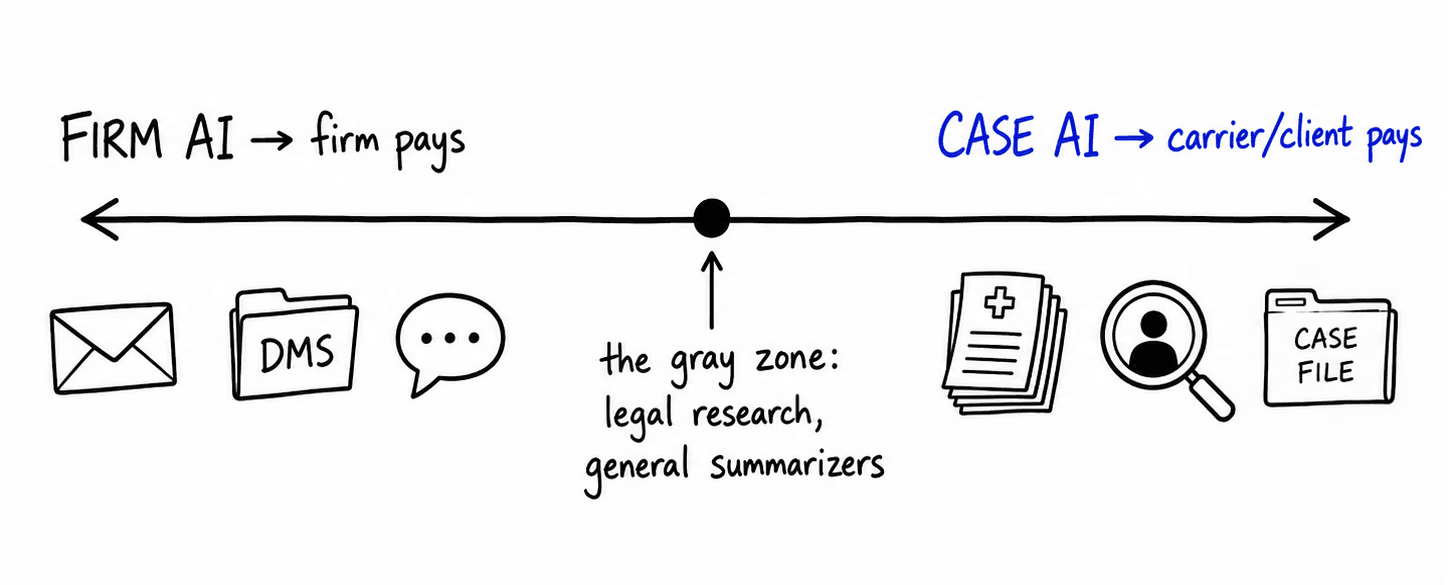
That gives us a clean split — Firm AI vs. Case AI.
Firm AI runs the office. Used across every matter at a flat cost, it's just infrastructure — email, a document system, a firmwide chatbot. The firm pays.
Case AI does work on one matter, for one client, from that case's specific context: a medical chronology for one claim, an investigation of one opposing expert, a contradiction analysis across one case's depositions. That's a matter cost, and it can be billed to the carrier.
Carriers are already writing AI use into their rules — focused on disclosure, verification, confidentiality, time-entry transparency, and limits on what can be charged. The Hartford's panel guidelines require firms to disclose AI use, name the tool in the time entry, verify outputs, and protect confidential data.
Category | What it is | Who pays |
|---|---|---|
Practice-infrastructure AI | Runs the whole firm (email, DMS, firmwide chatbot) | The firm — it's overhead |
Hybrid-productivity AI | Helps on matters but broadly useful (general research, generic summarizer) | The gray zone — depends on disclosure and pricing |
Matter-specific work product | Built for one case, from its records (chronology, expert investigation) | The carrier, if pre-approved and passed through at cost |
A 3-question test for AI billing
Not sure which bucket? Run these three. All three point to the case → reimbursable Case AI. Point to the firm → overhead.
But-for — would this cost exist if this case didn't? A firmwide subscription is there regardless. An expert investigation on this file's opposing witness exists only because of this case.
The meter — does the cost run on this matter, or is it flat? ABA 512 draws the line here: a flat, built-in tool is overhead; a per-use charge on one client's records is billable.
Work product — does it build a specific deliverable, from this case's records, the client directly benefits from? A chronology of this claimant's file is work product. A generic chatbot isn't.
A firmwide chatbot fails all three — firm pays. An expert investigation on a specific opposing witness passes all three — case cost, treated like hiring a court reporter: disclosed, approved, passed through at cost.
How this solves the currently mis-aligned system
Let's start with what's broken. Take the medical chronology: an attorney reads thousands of pages by hand, pulling dates and providers and tying the timeline to liability, damages, and causation.
Say it takes 20 hours at $350/hour — $7,000 of real work. Carrier billing guidelines write it down 30%, so the firm gets paid for $4,900 and eats $2,100 for work it actually did. The carrier pays that $4,900 and still waits two weeks for a manual summary.
Now treat the AI as Case AI. The AI runs the first pass at a defined, matter-specific cost — say $300 — and the attorney reviews and signs off in about 5 hours ($1,750). That's roughly $2,050 total, delivered in days, not weeks.
Line them up and the old way is lose-lose: the carrier pays more ($4,900) for less — a slower, manual product — while the firm eats $2,100 in write-downs. The AI way flips both: the carrier pays less (~$2,050) for more — faster, source-cited work — and the firm stops eating write-downs. The attorney's remaining time goes to strategy and causation instead of clerical review.

AI's bigger value for defense is litigation intelligence
Beyond saving time, AI unlocks something new: litigation intelligence.
Litigation intelligence is analysis that was never practical to do by hand. For example: reading an opposing expert's entire deposition history and flagging every time they contradicted the opinion they're giving in your case.
A person could do it in theory, but no case could ever justify the hours. So it didn't get done.
For law firms, this is a new blue ocean. It gives attorneys sharper insight to win cases, and it lets them offer carriers a whole category of work they could never deliver before.
For insurers, it unlocks better outcomes. They get intelligence that was previously impossible, for a cost that is tiny next to the hundreds of billions the industry spends on claims every year.
And this is exactly where carriers are heading. In the 2026 study, their top ask of law firms shifted to "more accurate exposure analysis," with billing compliance falling to #5. They want better outcomes and better intelligence, not just lower bills.
The missing link
This is the missing link. For all of it to click — aligned incentives, a new market for litigation intelligence, adoption that actually scales — someone has to build a platform made for defense litigation, where the product and the billing model fit how firms and carriers actually work together.

That's what newcase.ai is built to be: purpose-built litigation intelligence for insurance defense — source-cited medical chronologies, deposition intelligence, expert-witness investigation — paired with a billing model designed around carrier guidelines, Case AI and firm–carrier collaboration.
And it's already working.
Firms on newcase.ai are getting reimbursed by their carriers. And their usage is scaling fast as the insurers see the ROI.
When the AI is priced and approved as a matter expense, the standoff ends: the firm adopts, the carrier gets the value, and the insured gets a better defense.
————————————————————————————————
FAQ
Who should pay for AI in insurance defense?
It depends on what the AI does. If it's Firm AI — a firm-wide tool used across every matter — it's overhead, and the firm pays. If it's Case AI — work on one matter, from that case's own records, like a medical chronology or expert investigation — it may be reimbursable by the carrier when disclosed, pre-approved, consistent with carrier guidelines, and passed through at actual cost. Under ABA Opinions 93-379 and 512, the key distinction is overhead vs. matter-specific pass-through cost. We're already seeing national carriers approve matter-specific AI, including through newcase.ai, as a reimbursable case expense.
Can a law firm charge a client or carrier for AI costs?
Sometimes. A general, firm-wide AI subscription is overhead the firm can't bill. But a service that charges per use on a specific client's records may be a billable out-of-pocket cost — at actual cost, no surcharge, disclosed in advance, and subject to the carrier's billing guidelines. Attorneys can also only bill for the actual time spent reviewing the work, not the hours the AI saved.
What is the difference between Firm AI and Case AI?
Firm AI runs the office and is used across every matter — email, a document system, a firm-wide chatbot — so the firm pays for it as overhead. Case AI does work on one matter, from that case's own records, to produce a specific deliverable like a chronology or expert investigation — so it may be reimbursable by the carrier as a matter expense when disclosed, approved, and passed through at cost.
Do insurance carriers allow defense firms to use AI?
Increasingly yes, but with rules. The Hartford's panel-counsel guidelines, for example, require firms to disclose AI use, name the specific tool in the time entry, verify every output, and protect confidential data before entering it into any system. That does not mean generic AI subscriptions or licenses are reimbursable. Expect disclosure, verification, itemization, and limits on what can be charged to become standard across carrier billing guidelines.
Is AI accurate enough to rely on in insurance defense litigation?
Only if it's purpose-built for litigation. Generic tools hallucinate — a public database now tracks more than 1,700 legal decisions involving AI hallucinations or alleged hallucinations, including fabricated citations, false quotes, and misrepresented authorities. Defense-grade AI has to be built for the work: citing every fact to the source page and keeping an attorney reviewing and signing off. Used that way it's more consistent and easier to audit than manual work — but it never replaces attorney judgment.
Is AI secure and compliant enough for confidential case and medical data?
It has to be. Insurance defense runs on privileged records and protected health information, so any AI that touches them must be secure and compliant — SOC 2 Type II controls, HIPAA-aligned handling through signed BAAs, and no retention of your data for model training. If a tool can't show you its security and compliance posture, it shouldn't touch your case files.
Sources